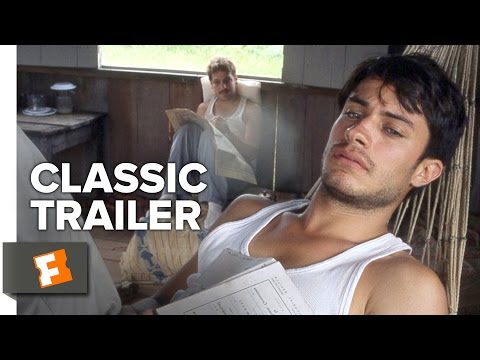
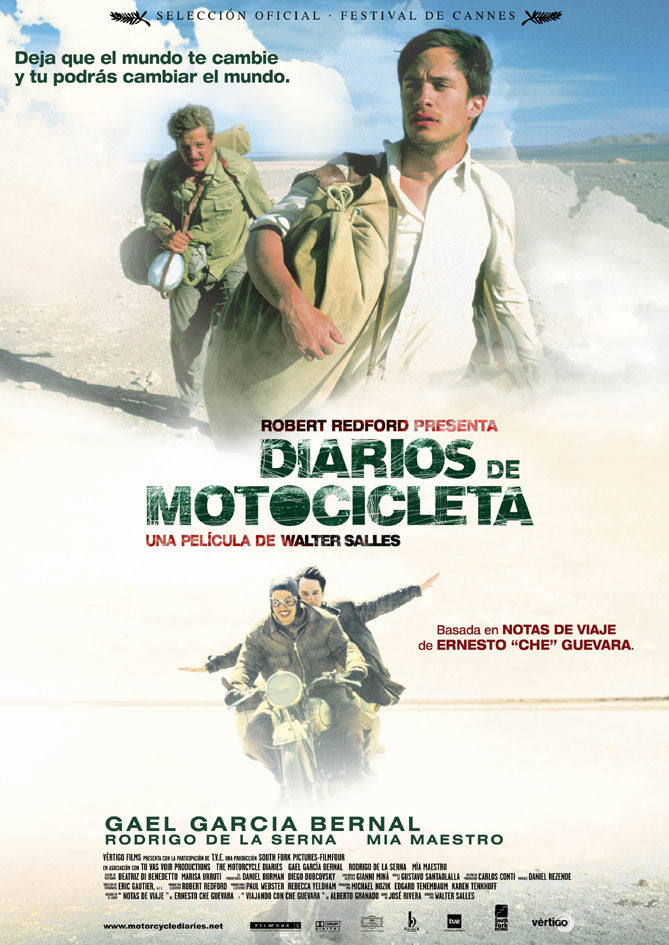
Two young Argentines — a medical student named Ernesto Guevara and his friend Alberto Granado — set off in January 1952 on a Norton 500 motorcycle to travel the length of South America. The motorcycle breaks down almost immediately. They continue anyway, increasingly on foot, by boat, by any means available. By the end of the journey, Ernesto is no longer who he was. The film doesn't tell you that. It shows you his face changing as he sees things he cannot unsee. That transformation is one of the most powerful learning experiences you can give a Spanish class.
Diarios de Motocicleta (Walter Salles, 2004) traverses Argentina, Chile, Peru, Colombia, and Venezuela — offering students a panorama of Latin American Spanish accents, regional vocabulary, and social realities in a single film. The language shifts as the geography shifts: Buenos Aires Spanish gives way to Andean Spanish, which gives way to Amazonian cadences. For ear training and regional vocabulary, this film has no equal in the Spanish-language classroom.
📬 Stay in the loop. New lessons added regularly — join the list to hear when your film is available.
Key Themes for the Classroom
- Travel as education: Ernesto and Alberto are transformed by what they see — the miners of Chuquicamata, the lepers of San Pablo, the indigenous dispossession everywhere they look. Ask students: what experiences have changed how you see the world? What did you have to witness to understand it?
- Latin American poverty and land: The film is a ground-level view of mid-century Latin American inequality. Use it to teach the vocabulary of tierra, trabajo, pobreza, injusticia, solidaridad — and to discuss what those words meant to people living them.
- Solidarity vs. observation: Ernesto begins the journey as an observer, writing in his diary. He ends it as someone who has swum across a river to be with people who have nothing. Ask students: at what point does bearing witness become insufficient? When does observation become complicity?
- Identity and becoming: The Ernesto who returns from this trip is partway to becoming someone else — someone who will eventually appear on walls all over the world. The film doesn't moralize about that. Ask students: what would you have to see to become someone different?
One Scene to Use
The San Pablo leper colony sequence — where Ernesto and Alberto volunteer for two weeks, and Ernesto on his birthday swims the Amazon River to join the patients celebrating on the other bank — is the film's emotional and moral center. It's also visually and linguistically clear. After watching, ask students to write Ernesto's diary entry for that night in Spanish. They've seen the day. Now they give it words.
One Low-Prep Classroom Activity
The film covers nine countries in roughly two hours. Give students a map of South America and ten minutes to trace the route as they watch, noting one Spanish word or phrase from each region. At the end of the film, share maps and compare vocabulary. The activity builds geographic literacy alongside linguistic ear training — and it requires zero preparation beyond the map.
The full Spanish lesson plan for Diarios de Motocicleta is ready at filmarobics.com/products/diarios-de-motocicleta — $29.95.
📬 Stay in the loop. New lessons added regularly — join the list to hear when your film is available.
Students who work through this unit leave with Spanish grounded in an entire continent — and with the understanding that language acquisition is inseparable from the willingness to be changed by what you hear.