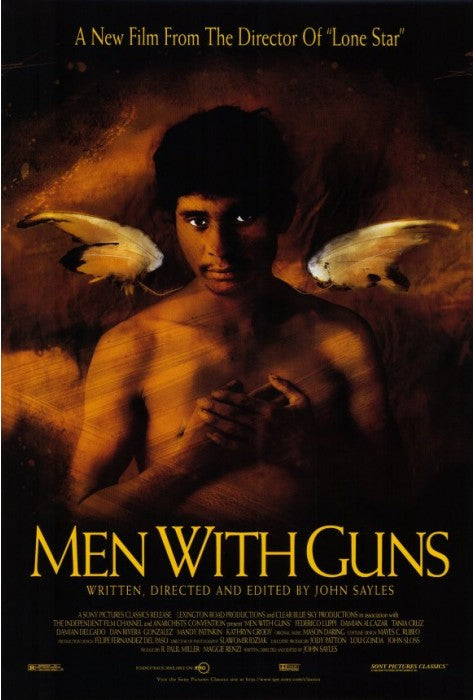

John Sayles made Hombres Armados (Men with Guns, 1997) entirely in Spanish because it wouldn't have worked any other way. A Mexican-American doctor named Fuentes has trained a group of young physicians to work in indigenous villages — and he has spent his career not knowing what happened to them. When he retires, he sets out to find them. What he finds is a Latin American country systematically eliminating its indigenous people, and a truth he spent decades not seeing because it was convenient not to see it. The film is in Spanish, but the indigenous communities the doctor reaches speak languages he doesn't understand — and that linguistic barrier is the film's moral argument made audible.
For Spanish students, the film offers a genuinely unusual linguistic experience: a Spanish-language film where Spanish itself is a language of power and exclusion. The indigenous characters speak Nahuatl and Mayan languages; the soldiers and officials speak Spanish; the doctor speaks Spanish and cannot bridge the gap. Students hear Spanish as a language with a political history — the language of colonization, of official documentation, of the systems that marginalize the people who don't speak it. That is an advanced and important perspective on the language they're learning, and the film provides it with complete moral honesty. Several scenes also feature Amerindian languages alongside Spanish, which gives students a visceral experience of linguistic difference.
📬 Stay in the loop. New lessons added regularly — join the list to hear when your film is available.
Key Themes for the Classroom
- Ignorance and complicity — Fuentes didn't know because he chose not to. Ask: ¿Es Fuentes responsable de lo que no sabe? Is there a moral difference between active participation in injustice and willful blindness to it?
- Language and power — The indigenous communities speak languages the doctor and the soldiers don't. Ask: ¿Qué significa no poder comunicarse con las víctimas? Who benefits from that incommunicability?
- Medicine and complicity — Fuentes trained doctors to help communities that the state was destroying. Ask: ¿Puede una persona trabajar para el bien dentro de un sistema injusto? Students debate the limits of individual good within corrupt systems.
Scene to use: Fuentes's first encounter with a village that has been destroyed — and his conversation with the survivor who speaks only an indigenous language, mediated by a child who speaks Spanish. The layers of translation in this scene are explicit: indigenous language → child's Spanish → Fuentes's Spanish → the audience's comprehension. Ask students: ¿Qué se pierde en cada paso de la traducción? And: what does the child's Spanish tell you about where this community fits in the country's hierarchy?
Low-prep classroom activity: Students write a brief reflection in Spanish from Fuentes's perspective — the evening after his first encounter with real evidence of what happened. He must acknowledge one thing he knew but didn't pursue, describe what he saw, and state one thing he will do next. The constraint requires students to write in Spanish about moral failure — a demanding register that requires both the vocabulary of guilt and the vocabulary of intention.
The full Spanish lesson plan for Hombres Armados is ready at filmarobics.com/products/hombres-armados — $29.95.
Students walk away from Hombres Armados having heard Spanish carry the weight of a political crime — and having understood that the language they're learning has a history that includes the people who were silenced by it.
The full Spanish lesson plan for Hombres Armados is ready at filmarobics.com/products/hombres-armados — $29.95.
📬 Stay in the loop. New lessons added regularly — join the list to hear when your film is available.
Students walk away from Hombres Armados having heard Spanish carry the weight of a political crime — and having understood that the language they're learning has a history that includes the people who were silenced by it.