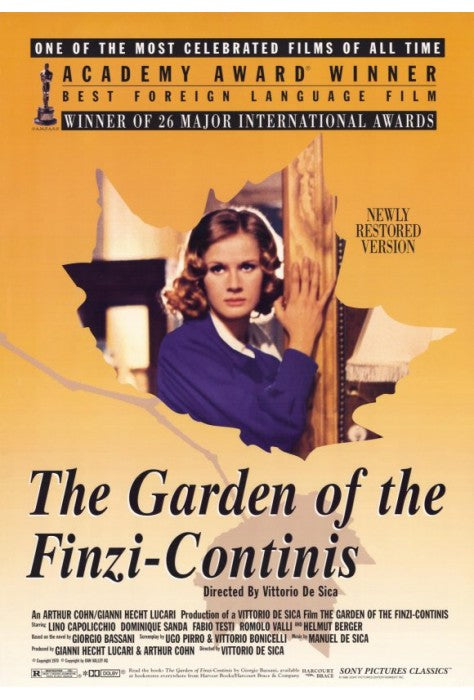
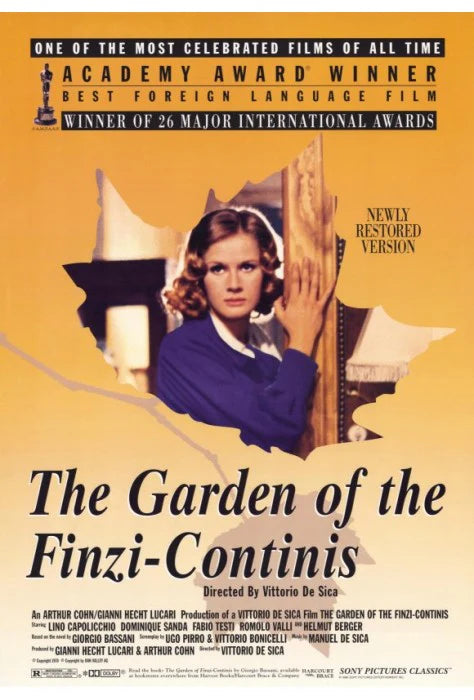
The garden of the Finzi-Continis is walled. Outside the wall, the Italian racial laws of 1938 are taking effect — Jewish Italians are being excluded from libraries, universities, tennis clubs. Inside the wall, the Finzi-Contini family creates a kind of beautiful suspension: private tennis courts, private library, private parties, private languages. Vittorio De Sica's 1970 film, winner of the Academy Award for Best Foreign Language Film, is a study in what it costs to pretend a wall is enough — and the price is paid not in drama but in the gradual, devastating withdrawal of a whole world. For an Italian class, it is one of the most historically important and linguistically rich films in the catalog.
For Italian students, the film's language is upper-bourgeois Italian of the late 1930s — formal, cultivated, and haunted. Micòl's speech is particularly rich: she and her brother use a private family language full of literary references and invented words, a language that exists only inside the garden wall. Students hear Italian as intimacy — language that belongs to a specific community and becomes illegible when that community is destroyed. The historical Italian racial laws (Leggi razziali) are woven into the dialogue, and students encounter the vocabulary of exclusion as it actually appeared in the language of the time: bureaucratic, polite, and perfectly designed to make discrimination legible as policy.
📬 Stay in the loop. New lessons added regularly — join the list to hear when your film is available.
Key Themes for the Classroom
- Denial and disaster — The Finzi-Continis refuse to believe the wall won't hold. Ask: Perché la famiglia non vuole lasciare l'Italia? Is their denial comprehensible or impossible to justify? Students debate whether understanding their position requires judging it.
- Memory and loss — The film is narrated from after, by someone who survived. Ask: Come cambia il modo in cui guardiamo il passato quando sappiamo cosa succede dopo? What does it mean to watch happiness knowing how it ends?
- Love and class — Giorgio loves Micòl, but she won't have him, for reasons she never fully explains. Ask: Perché Micòl rifiuta Giorgio? The answer is not simple, and it generates genuine discussion about class, intimacy, and what people protect themselves from.
Scene to use: Micòl giving Giorgio a private tour of her family's estate — explaining its history, its secrets, its peculiarities. The Italian in this scene is warm, specific, and completely private — the language of someone showing you everything that belongs only to them. Ask students: Cosa vuole Micòl che Giorgio capisca di questa visita? And then: Capisce? Students track the gap between what Micòl offers and what Giorgio takes.
Low-prep classroom activity: Students write a brief description in Italian of a place that belongs only to them — a room, a garden, a corner of somewhere. They must describe it in enough detail that someone who has never seen it could picture it, using present tense and sensory language. Then: imagine that place is about to disappear. Write one sentence about what you would want someone to remember about it. The constraint forces students to move from description to elegy, which is a real and demanding register in Italian.
The full Italian lesson plan for Il Giardino dei Finzi-Contini is ready at filmarobics.com/products/giardino-dei-finzi-contini — $29.95.
Students walk away from Il Giardino dei Finzi-Contini having heard Italian used for beauty, intimacy, and the specific grief of a world that chose to disappear — and they'll understand something about Italian history that no textbook reaches.
The full Italian lesson plan for Il Giardino dei Finzi-Contini is ready at filmarobics.com/products/giardino-dei-finzi-contini — $29.95.
📬 Stay in the loop. New lessons added regularly — join the list to hear when your film is available.
Students walk away from Il Giardino dei Finzi-Contini having heard Italian used for beauty, intimacy, and the specific grief of a world that chose to disappear — and they'll understand something about Italian history that no textbook reaches.