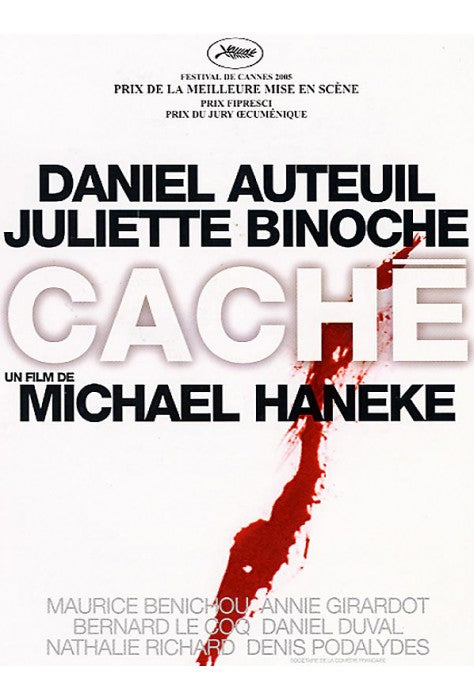

Michael Haneke gives you a mystery and then refuses to solve it — and that refusal is the film. Caché (Hidden) opens with a long, unmoving shot of a Paris street, and we realize gradually that someone has been recording this street and leaving the tapes at the home of Georges Laurent, a successful television literary critic. Who is watching? What do they want? The film never answers. What it does instead is something more interesting: it traces what guilt looks like in a man who believes he has buried his past completely.
For French students, Caché offers upper-register contemporary French in a bourgeois Parisian household — the language of educated professional people who are very good at saying things without meaning them. Georges's French is smooth, controlled, and consistently evasive; his wife Anne pushes past the surfaces; the Algerian man Majid barely speaks and says everything. Students learn to read the gap between French eloquence and French honesty.
📬 Stay in the loop. New lessons added regularly — join the list to hear when your film is available.
Key Themes for the Classroom
- Guilt and repression — Georges did something terrible to Majid as a child and has spent his adult life not thinking about it. The surveillance forces him to. Ask: Pourquoi Georges refuse-t-il de parler de son passé? What is he protecting?
- France and Algeria — The film is set against the shadow of French colonialism and specifically the October 1961 Paris massacre of Algerian protesters. Students don't need to know this history going in — the film teaches it — but it transforms what they thought was a psychological thriller into something larger.
- Surveillance and innocence — The film never resolves who is watching. That ambiguity forces students to ask: does it matter? Is Georges guilty regardless of who sent the tapes?
Scene to use: Georges visits Majid for the second time, and Majid demonstrates — in real time, in front of Georges — that he has nowhere to go. The scene is almost wordless. Its French is plain, direct, and devastating. Ask students afterward: Qu'est-ce que Majid veut que Georges comprenne? Then: Georges comprend-il? That gap between understanding and acknowledging is the film's entire argument.
Low-prep classroom activity: After watching the film, students write a short monologue in French from Georges's perspective — not an apology (he doesn't apologize), but an explanation. He must use at least one justification, one acknowledgment of what he did, and one sentence that changes the subject. The constraint requires students to write evasion in French, which is a real and learnable register.
What to listen for: Haneke's characters talk past each other constantly — the conversations in Caché are between people who cannot say what they mean because what they mean implicates them. Georges's French is the French of a man managing his image in real time: articulate, reasonable, and carefully constructed to prevent accountability. Majid's French is quieter and more direct. Ask students: Pourquoi Georges ne répond-il jamais directement aux questions de Majid? The evasion analysis is a grammar lesson in the French of indirect speech.
The full French lesson plan for Caché is ready at filmarobics.com/products/cache — $29.95.
Students walk away from Caché having heard French used by someone trying very hard not to be seen — and having learned that surveillance, guilt, and language are all versions of the same question: who gets to control the story?
The full French lesson plan for Caché is ready at filmarobics.com/products/cache — $29.95.
📬 Stay in the loop. New lessons added regularly — join the list to hear when your film is available.
Students walk away from Caché having heard French used by someone trying very hard not to be seen — and having learned that surveillance, guilt, and language are all versions of the same question: who gets to control the story?