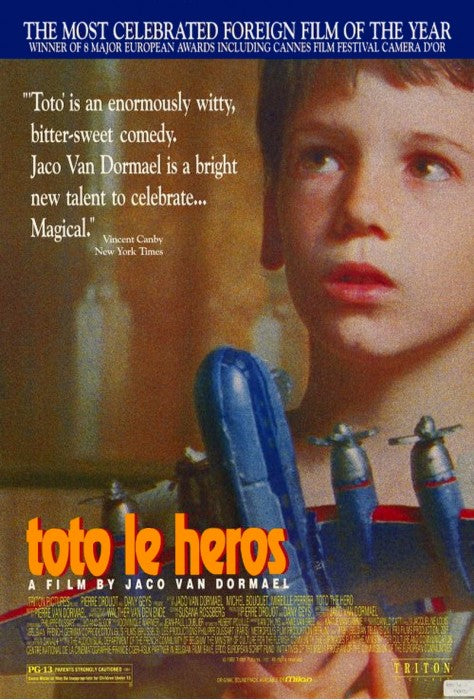

Thomas has believed his entire life that he was switched at birth — that the wealthy Kant family next door got his life, and he got theirs. He has spent decades nursing this conviction. Toto le Héros is Jaco van Dormael's 1991 debut film, and it is one of the most structurally inventive movies in the French catalog: told in fragments that move between Thomas as a child, Thomas as a middle-aged man, and Thomas as an elderly man in a nursing home, each layer adding another piece to the story of a life lived in grievance. For a French class, it's a masterclass in how narrative time works in French.
The film's French is Belgian — van Dormael is Belgian, the film is set in Belgium — and students encounter a French that is slightly different from Parisian French in rhythm and certain vocabulary choices. That difference is itself a lesson: French is not monolithic, and the French of Belgium has a distinct texture that students hear without being told to notice it.
📬 Stay in the loop. New lessons added regularly — join the list to hear when your film is available.
Key Themes for the Classroom
- Memory and self-narrative — Thomas's story is unreliable. The film knows it; he doesn't. Ask: À quel moment le spectateur comprend-il que Thomas s'est peut-être trompé toute sa vie? What clues does the film give you?
- Grievance and wasted life — Thomas has spent his life in an imagined injustice. Ask: Qu'est-ce que Thomas aurait pu avoir s'il n'avait pas fixé son attention sur Alfred? What did the grievance cost him?
- Time and regret — The film moves between Thomas's life stages without warning. Ask: Pourquoi van Dormael mélange-t-il les époques? What does the fragmented structure tell us about how memory works?
Scene to use: The childhood section — Thomas and Alfred as boys, their friendship and rivalry, the fire. The Belgian French of childhood is warm and specific, and the seeds of Thomas's entire grievance are planted in scenes that feel innocent and loving. After watching, ask: Qu'est-ce que Thomas comprend de ce moment? Qu'est-ce qu'il ne comprend pas encore?
Low-prep classroom activity: Students write a brief account in French of a time they believed something unfair had happened to them — a real or invented story. They must write it twice: once as they remembered it, and once as it actually happened (or might have happened). The gap between the two versions is the lesson about memory, narrative, and self-deception in French.
What to listen for: The film moves between three time periods — child Thomas, middle-aged Thomas, elderly Thomas — and the French of each is subtly different. The child's French is immediate and certain; the middle-aged Thomas's French is marked by frustration and hypothesis; the elderly Thomas's French is both resigned and dangerous. Ask students to identify one line spoken by Thomas at two different ages and describe how the same idea sounds different depending on when it is said. The temporal register shift is the film's structural argument made audible.
The full French lesson plan for Toto le Héros is ready at filmarobics.com/products/toto-le-heros — $29.95.
Students walk away from Toto le Héros having heard Belgian French carry a life's worth of grievance and regret — and having thought seriously about the stories we tell ourselves to explain why our lives went the way they did.
The full French lesson plan for Toto le Héros is ready at filmarobics.com/products/toto-le-heros — $29.95.
📬 Stay in the loop. New lessons added regularly — join the list to hear when your film is available.
Students walk away from Toto le Héros having heard Belgian French carry a life's worth of grievance and regret — and having thought seriously about the stories we tell ourselves to explain why our lives went the way they did.