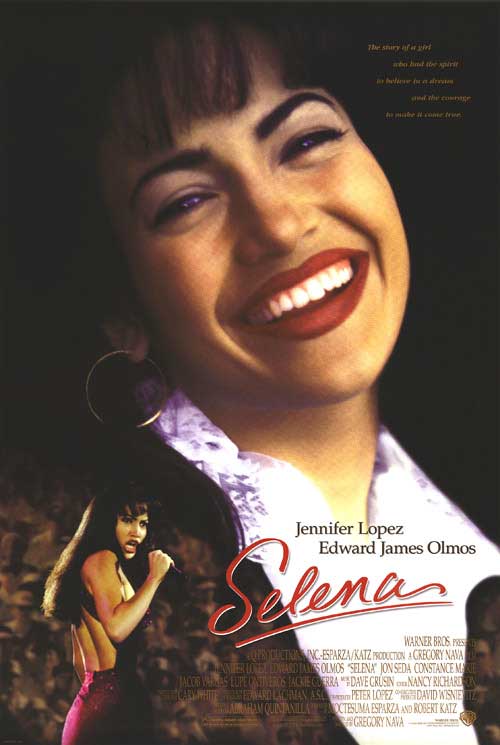
Selena Quintanilla-Pérez is twelve years old and has just performed for the first time. Her father Abraham, who manages the family band, gives her a speech that will stay with your students: to succeed in the United States, she needs to be more Mexican than Mexicans and more American than Americans. To be Tejano is to live in two cultures and be fully accepted in neither. That tension — and Selena's extraordinary response to it — is the most honest thing this film offers a Spanish classroom.
Selena (Gregory Nava, 1997) is uniquely positioned for the Spanish classroom because it foregrounds the experience of Spanish in America — code-switching, cultural negotiation, the complexity of identity for Latinx students who may live exactly what the film describes. Selena herself learned Spanish phonetically because she grew up speaking English at home; her Spanish was passionate and sincere and imperfect. That imperfection is pedagogically important: it tells students that authenticity matters more than perfection.
📬 Stay in the loop. New lessons added regularly — join the list to hear when your film is available.
Key Themes for the Classroom
- Bilingual identity: The film's central tension — being "not Mexican enough" for Mexico and "not American enough" for the U.S. — is live for many of your students. Ask them directly: have you ever felt like you didn't belong fully to either of the cultures you carry? What Spanish vocabulary describes that experience: la identidad, pertenecer, entre dos mundos, el puente?
- Family and ambition: Abraham Quintanilla is both the reason Selena succeeds and, arguably, a reason she never has full ownership of her own life. Ask students: what do parents owe children who are exceptional? What do children owe parents who sacrificed for their success?
- Tejano music as cultural resistance: Tejano music is neither Mexican nor American — it's a third thing that grew up in the space between. Discuss: what other art forms have emerged from cultural in-betweenness? What do they accomplish that mainstream culture cannot?
- Fame and vulnerability: Selena's story ends with her murder by the president of her fan club — someone who claimed to love her most. Ask students: what does the film say about the cost of being known? About being loved publicly but not protected privately?
One Scene to Use
The scene at the Houston Astrodome — 1995, 61,000 people — where Selena commands an arena with her voice and her presence is one of the great concert film moments in cinema. But watch it in Spanish class specifically for the crowd's response: bilingual chants, Spanish lyrics, English commentary from the announcer. The linguistic mixing is the scene. After watching, have students describe what they heard — not what they saw — in Spanish.
One Low-Prep Classroom Activity
Pull the scene where Abraham gives Selena the speech about being "more Mexican than Mexicans, more American than Americans." Transcribe the key lines. Students work in pairs: one argues that Abraham is right, one argues that he's wrong. They make their case in Spanish, three minutes each. The position doesn't have to be their real opinion. The argument does have to be in Spanish.
The full Spanish lesson plan for Selena is ready at filmarobics.com/products/selena — $29.95.
📬 Stay in the loop. New lessons added regularly — join the list to hear when your film is available.
Students who work through this unit leave with more than Spanish vocabulary — they leave with a framework for thinking about what language is for, and what it costs to be caught between two of them.