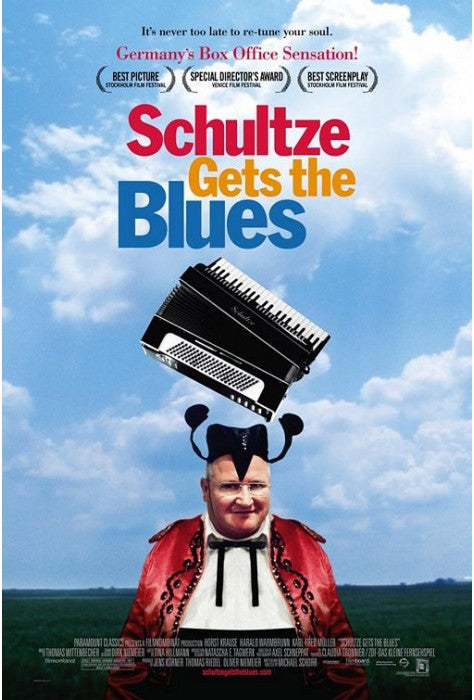
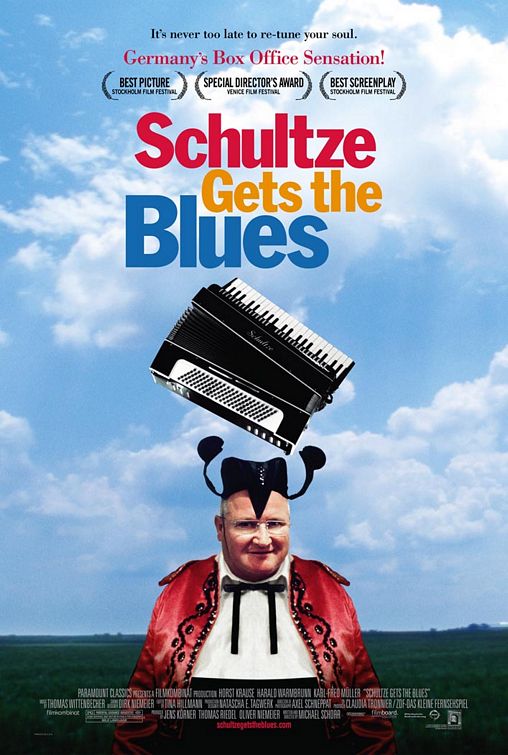
Schultze is retired. He's from a small mining town in Saxony, and for thirty-seven years he played accordion in the local German folk tradition — polkas, waltzes, the music of his village. Then he hears zydeco on the radio one night, and something happens to him. The rest of the film is about what a man does when the music that calls him is not the music he was raised to play. Schultze Gets the Blues is a gentle, almost wordless German film about cultural encounter, and it belongs in any German class that wants to talk about what it means when your tradition doesn't have room for who you're becoming.
For German students, the film offers Saxon German — the dialect of the former East, with its distinct phonology and rhythm — in a story about a man who doesn't have many words and doesn't need them. The film's pedagogy is almost entirely visual and musical, which means students at any level can follow it, and the few scenes of dialogue are compact and emotionally clear.
📬 Stay in the loop. New lessons added regularly — join the list to hear when your film is available.
Key Themes for the Classroom
- Cultural exchange and authenticity — Is it authentic for Schultze to play zydeco? What does "authentic" music mean? Ask: Hat Schultze das Recht, eine Musik zu spielen, die nicht aus seiner Kultur kommt?
- Community and conformity — Schultze's village friends don't understand his new passion and are quietly disapproving. Ask: Was riskiert Schultze, indem er neue Musik spielt?
- Finding yourself late — The film is about a man who discovers something new about himself at retirement age. Ask: Ist es je zu spät, etwas Neues zu lernen?
Scene to use: Schultze's first performance of zydeco at the local music festival — the audience's bewilderment, the committee's polite disapproval, and Schultze's complete unselfconsciousness about all of it. The German in the surrounding scenes is the language of village social expectation — polite, concerned, mildly condescending. Ask: Wie reagieren die anderen auf Schultzes neue Musik? What do their reactions reveal about the community's values?
Low-prep classroom activity: Students write a brief letter in German from Schultze to a friend — after the festival, explaining what happened and why he's not going to stop playing the new music. He must use at least one expression of his new passion, one acknowledgment of the community's disapproval, and one statement about what music means to him now. The constraint produces German writing that is simple, direct, and emotionally honest.
What to listen for: The film is almost silent — Schultze is not a talker, and much of what happens between him and other characters happens in the pauses. His German, when he speaks, is the German of a man who has said everything he needs to say in thirty-seven years and sees no reason to add to it. Ask students to identify one scene where Schultze communicates something important without words, and describe in German what he communicated. The exercise — describing nonverbal communication in language — is a genuinely advanced metalinguistic task.
The full German lesson plan for Schultze Gets the Blues is ready at filmarobics.com/products/schultze-gets-the-blues — $29.95.
Students walk away from Schultze Gets the Blues having heard Saxon German carry one man's quiet revolution — and having thought about what it means to discover a part of yourself that your community has no room for.
The full German lesson plan for Schultze Gets the Blues is ready at filmarobics.com/products/schultze-gets-the-blues — $29.95.
📬 Stay in the loop. New lessons added regularly — join the list to hear when your film is available.
Students walk away from Schultze Gets the Blues having heard Saxon German carry one man's quiet revolution — and having thought about what it means to discover a part of yourself that your community has no room for.