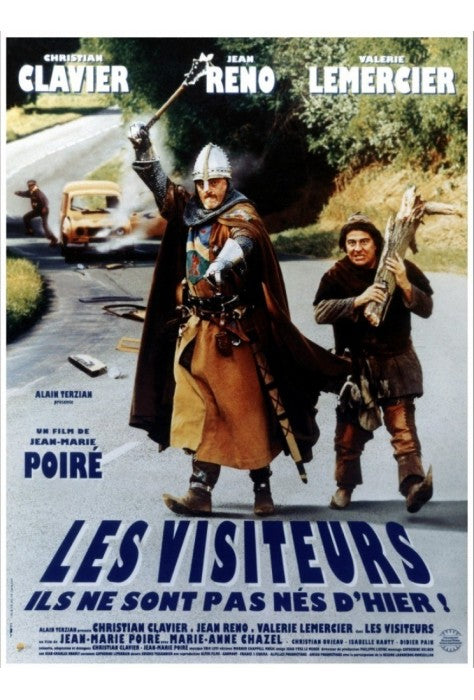

A medieval knight named Godefroy and his serf Jacquouille are sent forward in time to 1990s France. The knight is confused and horrified; the serf, who had nothing in the 12th century, is delighted by everything democracy offers. Jean-Marie Poiré's Les Visiteurs (1993) is the highest-grossing French film of its decade, and for a French class it offers something genuinely unusual: two registers of French from eight centuries apart, in the same film, used for comedy and for a surprisingly sharp observation about class and historical change.
For French students, the film is a double vocabulary lesson built in. Godefroy speaks an archaic, courtly French full of constructions students will not recognize; the modern French around him is contemporary and colloquial. The contrast is the film's engine, and it's also an excellent grammar teaching tool. Students who understand why the knight's French sounds wrong are demonstrating real language competence. The film is appropriate from B1 level upward and works well as a humorous introduction to French historical registers.
📬 Stay in the loop. New lessons added regularly — join the list to hear when your film is available.
Key Themes for the Classroom
- Class and social mobility — Jacquouille the serf is thrilled by modernity; his lord is appalled by it. Discussion: Qu'est-ce que chaque personnage révèle sur son époque par ses réactions au présent?
- Tradition vs. modernity — Godefroy's values are medieval; they collide with contemporary France at every turn. Discussion: Quelles valeurs médiévales Godefroy refuse-t-il d'abandonner? Should he?
- Language change over time — The film is an accessible demonstration that French has evolved dramatically. Students can identify: what does Godefroy say that nobody in the 20th century understands?
- French humor and cultural self-awareness — The film is partly about how France sees itself historically. Discussion: Qu'est-ce que la France apprécie et ce qu'elle rejette de son propre passé?
One Scene to Use
The scene where Godefroy first arrives at what is now his ancestral home — turned into a hotel — and encounters modern guests, plumbing, and electricity simultaneously. His response to each element of modernity, in medieval French, is the film's comedic thesis. Have students transcribe his reactions: what vocabulary does he reach for when he has no words for what he's seeing?
One Low-Prep Classroom Activity
Give students a short list of modern French words (voiture, téléphone, internet, démocratie) and ask them to write how Godefroy might describe each one, using only vocabulary available to a 12th-century French noble. This is a creative vocabulary exercise that reinforces both historical context and contemporary French word formation.
What to listen for: Les Visiteurs is a French class in itself: a medieval knight and his serf time-travel to the 1990s, and the entire comedy is the clash between archaic French and contemporary French. Students hear both varieties in the same scene, spoken by characters who cannot understand each other. Ask students to identify one word or phrase that Godefroy uses that no one around him understands, and explain in French what the modern equivalent is. The exercise teaches French diachronic change through laughter.
The full French lesson plan for Les Visiteurs is ready at filmarobics.com/products/teach-les-visiteurs-french-class — $29.95.
Students finish this unit with vocabulary spanning eight centuries of French — and the understanding that language is one of the clearest records of how a society changes.
The full French lesson plan for Les Visiteurs is ready at filmarobics.com/products/teach-les-visiteurs-french-class — $29.95.
📬 Stay in the loop. New lessons added regularly — join the list to hear when your film is available.
Students finish this unit with vocabulary spanning eight centuries of French — and the understanding that language is one of the clearest records of how a society changes.