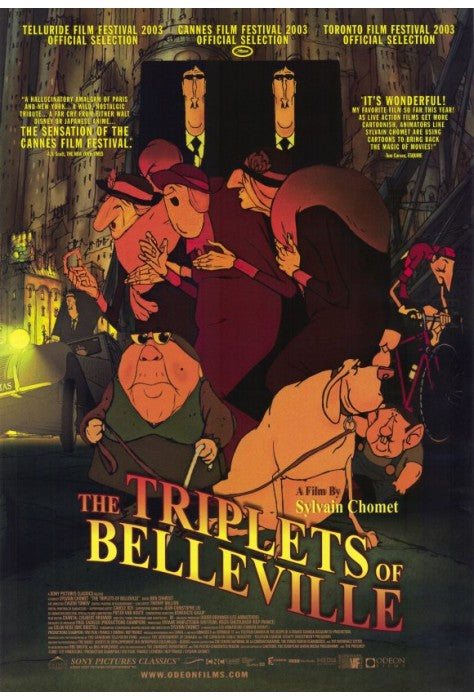

There is almost no dialogue in Les Triplettes de Belleville. Sylvain Chomet's 2003 animated film tells its story entirely through image, music, and the expressive, silent faces of its extraordinary characters — a grandmother who will do anything to rescue her grandson from the Tour de France's criminal underworld. The film won the César Award and was nominated for Academy Awards, and for a French class it is one of the most unusual and most effective tools available: a film that makes students engage with French culture without needing to understand a single sentence.
The minimal dialogue that does appear is French, and its sparseness makes every word audible and significant. The film's true language is visual — the exaggerated bodies, the expressive animation, the satire of French and American culture that runs through every sequence. Students who watch it come to class with things to say about French culture that they couldn't have predicted they'd have opinions on.
📬 Stay in the loop. New lessons added regularly — join the list to hear when your film is available.
Key Themes for the Classroom
- Determination and sacrifice — Madame Souza is eighty years old and will travel to the other side of the ocean to rescue her grandson. Ask: Qu'est-ce qui motive Madame Souza? What does she represent about French grandmothers in particular?
- French vs. American culture — The film's satirical portrait of "Belleville" (a clearly American city) versus the French characters is immediately visible. Ask: Comment le film représente-t-il la culture américaine? Et la culture française? Are the stereotypes fair?
- Silent communication — Almost everything in this film is communicated without words. Ask: Comment les personnages expriment-ils leurs émotions sans paroles? Students practice describing emotion and action in French without having had it narrated for them.
Scene to use: The Tour de France sequence at the beginning — Champion's childhood training, the grandmother's methods, the race itself. The film's visual vocabulary of obsession, dedication, and the physical reality of cycling is fully established without a word. Use it to teach descriptive French: students narrate what they see in present tense, as if providing commentary for a listener who can't see the screen.
Low-prep classroom activity: Students write a brief scene description in French — narrating a two-minute section of the film they choose, in present tense, third person, with at least three sensory details, two action verbs, and one observation about what a character must be feeling. The task produces descriptive French writing with visual grounding rather than textbook prompts.
What to listen for: Sylvain Chomet's film is almost entirely without dialogue — which makes it, paradoxically, an excellent French language teaching tool. The few words that appear are precisely chosen; the sound design is itself a kind of language; and the film's visual storytelling gives students a complete narrative without linguistic scaffolding. Use it for descriptive French: pause every five minutes and have students narrate what they saw in French. The constraint forces them to find vocabulary for visual experience, which is exactly the kind of productive stretch that builds fluency.
The full French lesson plan for Les Triplettes de Belleville is ready at filmarobics.com/products/triplettes-de-belleville — $29.95.
Students walk away from Les Triplettes de Belleville having described French culture without a textbook — and having discovered that language is just one of the tools a story uses to mean something.
The full French lesson plan for Les Triplettes de Belleville is ready at filmarobics.com/products/triplettes-de-belleville — $29.95.
📬 Stay in the loop. New lessons added regularly — join the list to hear when your film is available.
Students walk away from Les Triplettes de Belleville having described French culture without a textbook — and having discovered that language is just one of the tools a story uses to mean something.