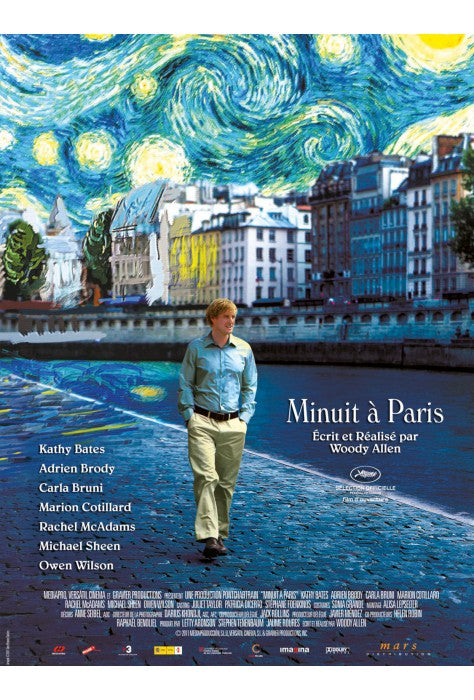

Gil Pender is a Hollywood screenwriter in Paris with his fiancée, who is not interested in what Gil is interested in. Every night at midnight, a vintage car appears and takes him back to 1920s Paris — Hemingway, Fitzgerald, Gertrude Stein, Picasso, Dali. The joke of Midnight in Paris is that Gil prefers the past to the present. The film's argument is that he's wrong, but it lets him be wrong for a long time in a very beautiful way. Woody Allen's most successful French production is also, for a language class, one of the most culturally rich films available.
For French students, the film offers Paris as a character — its streets, its rain, its specific beauty at night — while also offering the French literary and artistic milieu of the 1920s as educational content. Students encounter Gertrude Stein, Hemingway, and Fitzgerald not as names in a textbook but as people in a room, and the French and English they speak gives students immediate access to a major moment in Franco-American cultural history.
📬 Stay in the loop. New lessons added regularly — join the list to hear when your film is available.
Key Themes for the Classroom
- Nostalgia and the present — Gil believes he was born in the wrong era. Ask: Pourquoi Gil préfère-t-il le passé? And: Is he right? The film's answer is no, but it makes the case for both sides.
- Paris and cultural mythology — The Paris of the 1920s is one of the great myths of Western culture. Ask: Qu'est-ce que Paris représente pour les artistes de cette époque? And: What does it represent for Gil?
- Art and authenticity — Gil is a screenwriter who wants to be a novelist. Ask: Qu'est-ce que Gil cherche à Paris qu'il ne peut pas trouver à Hollywood?
Scene to use: Gil's conversation with Gertrude Stein about his novel — she reads it, she gives her opinion, and the French of literary judgment (its precision, its directness, its refusal to be merely polite) is fully present. Ask: Comment Gertrude Stein critique-t-elle le travail de Gil? Students analyze the specific language of French literary criticism.
Low-prep classroom activity: Students write a brief scene in French — Gil meeting one 1920s artist of their choice (they may invent their own version of the conversation). The artist must say something honest about Gil's situation that he doesn't want to hear, and Gil must respond in a way that shows he's heard it even if he doesn't admit it. Present tense, two characters, one truthful exchange.
What to listen for: Inez and Gil speak different English throughout the film — but when the film shifts to the 1920s sequences, the French of the period characters is deliberately theatrical and warm, the French of people who believed they were making history. Ask students to compare two lines: one contemporary French character (the tour guide, a museum employee) and one 1920s character (Hemingway, Gertrude Stein in French). What is different about the register? The temporal comparison teaches students that French, like every language, belongs to its moment.
The full French lesson plan for Midnight in Paris is ready at filmarobics.com/products/minuit-a-paris — $29.95.
Students walk away from Midnight in Paris having heard French carry the 1920s literary scene — and having thought about whether the past is better, or whether we just haven't been in it long enough to know the difficult parts.
The full French lesson plan for Midnight in Paris is ready at filmarobics.com/products/minuit-a-paris — $29.95.
📬 Stay in the loop. New lessons added regularly — join the list to hear when your film is available.
Students walk away from Midnight in Paris having heard French carry the 1920s literary scene — and having thought about whether the past is better, or whether we just haven't been in it long enough to know the difficult parts.