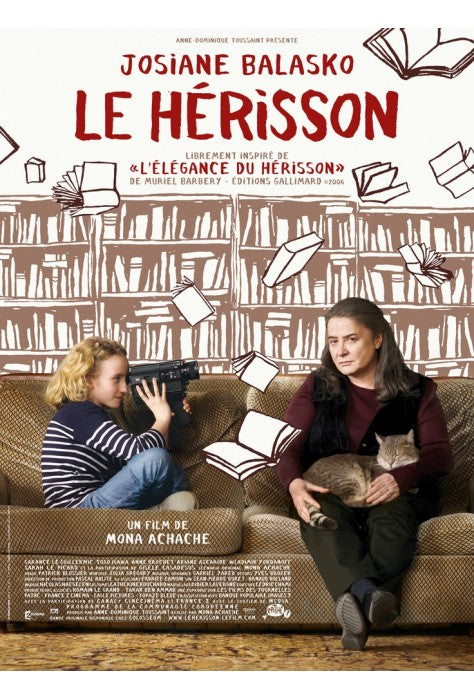

Renée Michel is the concierge of a bourgeois Paris apartment building. She is fifty-four, widowed, keeps a cat, and is believed by every tenant to be exactly what they assume a concierge should be: invisible, uneducated, and moderately stupid. She is in fact widely and secretly read, a devoted student of Dutch masters and Japanese cinema, and deeply private about all of it. Paloma is eleven, the daughter of one of the apartments' families, and planning to kill herself on her twelfth birthday because she has concluded that life is pointless. Kakuro Ozu is a Japanese widower who has just moved in. The three of them are about to find each other. Le Hérisson (The Elegance of the Hedgehog) is Muriel Barbery's novel brought to film, and it is the most philosophically generous classroom French film available.
For French students, the film offers three completely different registers of French in sustained collision: Renée's guarded, deliberately simplified register (the French she performs for the tenants), Paloma's precise, intellectually precocious French (the journal entries that narrate the film), and Kakuro's warm, slightly formal French (the French of someone who learned it as a second language with particular care). Students hear French as performance, as private thought, and as chosen courtesy simultaneously.
📬 Stay in the loop. New lessons added regularly — join the list to hear when your film is available.
Key Themes for the Classroom
- Authenticity and social performance — Renée performs stupidity to be left alone. Ask: Pourquoi Renée cache-t-elle qui elle est vraiment? Is she right to? What does concealment cost her?
- Class and cultural access — Renée has taught herself everything through books. Ask: Qu'est-ce que cela dit sur l'accès à la culture en France? Who is supposed to know about Tolstoy? What happens when someone unexpected does?
- Beauty and meaning — Paloma believes life has no meaning. Renée and Kakuro demonstrate that she's wrong. Ask: Qu'est-ce qui convainc finalement Paloma de changer d'avis?
Scene to use: Renée and Kakuro's first real conversation — the moment she stops performing and is herself with him. The French in this scene shifts from Renée's guarded, minimal register to something more open, more literary, more completely herself. Ask: Comment change le français de Renée dans cette scène? Students track the specific vocabulary and sentence structure changes.
Low-prep classroom activity: Students write a brief journal entry in French — in Paloma's voice, after she meets Kakuro. She must use her characteristic intellectual directness, describe one specific thing she observed in their interaction, and say one thing she has to revise about her theory of life. The task produces philosophically engaged French writing with a specific character voice.
What to listen for: Renée, the concierge, speaks two completely different Frenches depending on who she's talking to: the deliberately dull, grammatically imperfect French of the role she performs for the building's wealthy residents, and the intellectually rich, precisely beautiful French she actually possesses. Ask students to find one scene where Renée performs her concierge French and one where she drops it, and describe the difference. The exercise teaches students that register is a choice — and that the most interesting people are often those who hide their most interesting French.
The full French lesson plan for Le Hérisson is ready at filmarobics.com/products/le-herisson — $29.95.
Students walk away from Le Hérisson having heard French used as a tool of concealment, a medium of private thought, and a vehicle for genuine connection — all in the same film.
The full French lesson plan for Le Hérisson is ready at filmarobics.com/products/le-herisson — $29.95.
📬 Stay in the loop. New lessons added regularly — join the list to hear when your film is available.
Students walk away from Le Hérisson having heard French used as a tool of concealment, a medium of private thought, and a vehicle for genuine connection — all in the same film.