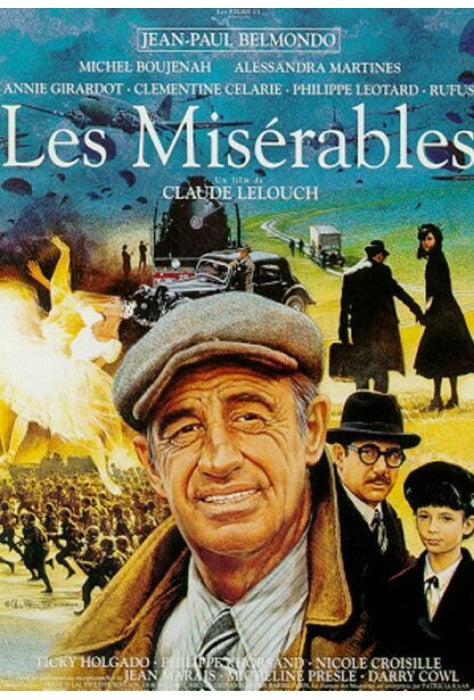

Claude Lelouch's Les Misérables does something no other adaptation of Victor Hugo's novel attempts: it transplants the moral architecture of the 19th century directly into the 20th. Jean-Paul Belmondo plays Henri Fortin, an illiterate removal man who, during the Nazi occupation of France, becomes the unwilling protector of a Jewish family — and finds himself living a version of Jean Valjean's story without ever having read the book. Your students watch two centuries of French history speak to each other. That is a lesson you cannot manufacture in a textbook.
At 175 minutes, Lelouch's Les Misérables is a film that demands patience — and rewards it. The language is rich, literary, and registers the full sweep of 20th-century French spoken across class lines: a working man, an occupied bourgeoisie, French-Jewish refugees, Nazi collaborators. Students encounter French as it was actually spoken across a half-century of upheaval. The vocabulary payoff is exceptional. And because Fortin is himself illiterate — unable to access Hugo's text — the film builds a remarkable meta-structure: a man living the novel he cannot read.
📬 Stay in the loop. New lessons added regularly — join the list to hear when your film is available.
Key Themes for the Classroom
- Justice across eras: Hugo's Jean Valjean was hounded by Inspector Javert for stealing bread. Fortin risks his life hiding Jews from Nazi collaborators. Ask students: what does justice mean when the law itself is unjust? The parallel is not accidental — Lelouch makes it structural.
- Illiteracy and moral clarity: Fortin cannot read Hugo, but acts with more humanity than those who can. Discuss with students: what is the relationship between education, morality, and conscience?
- The Occupation as mirror: The film was made 50 years after the events it depicts. Why was France still grappling with Vichy in 1995? This is a rich entry point for French postwar identity, memory, and the difficulty of confronting collaboration.
- Redemption through ordinary acts: No Jean Valjean here lifts a cart to save a stranger. Fortin's redemption is quiet, dangerous, and unglamorous. What does courage look like when it goes unrecorded?
One Scene to Use
The moment Fortin realizes the family he is hiding will not survive without him — and chooses to stay. There is no speech, no dramatic declaration. Belmondo conveys the decision in three seconds of stillness. Use it to teach the subjunctive of doubt and decision, and to ask students: what would you do?
One Low-Prep Classroom Activity
Before screening, give students a one-paragraph summary of Hugo's original Les Misérables. After the film, ask them to write a paragraph comparing Fortin and Valjean — two men, two centuries, one moral situation. The parallels write themselves. No extra prep required.
The full French lesson plan for Les Miserables is ready at filmarobics.com/products/les-miserables — $29.95.
📬 Stay in the loop. New lessons added regularly — join the list to hear when your film is available.
Students walk away from this film understanding that France's present is inseparable from its past — and that French is the language in which that reckoning happens.