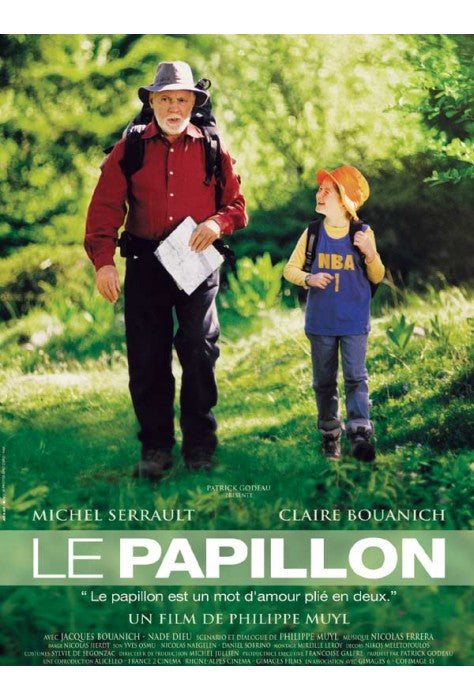
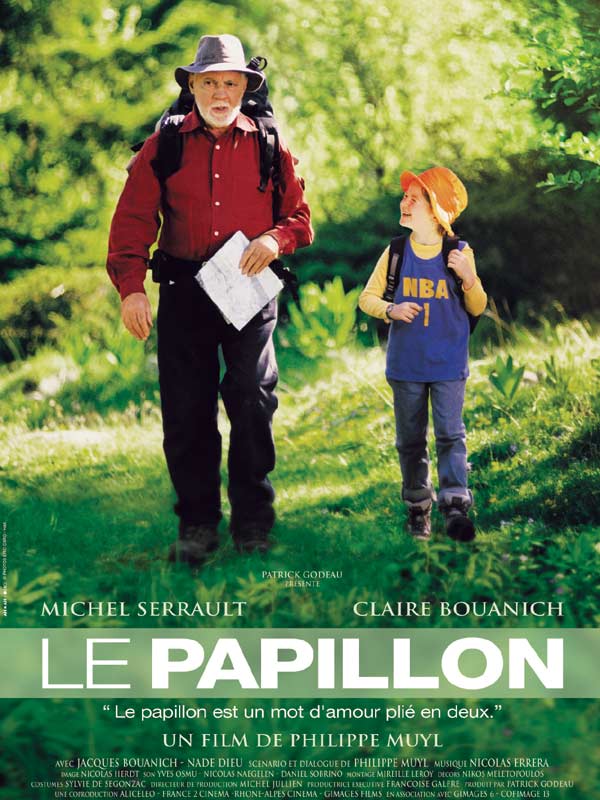
Julien is a retired entomologist — a butterfly specialist — who is cranky, solitary, and has no interest in children. Elsa is eight years old, lives next door, and has been left to fend for herself while her mother recovers from an accident. She attaches herself to Julien. He cannot shake her. By the time they've driven to the Alps to find the Isabelle butterfly, they are, despite everything, friends. Le Papillon is a gentle film about an unexpected connection, and for a French class it is one of the most reliable choices available — accessible, warm, and built on a friendship that generates real French conversation.
The film's French is one of its greatest assets: Elsa asks the kinds of questions children actually ask — direct, specific, slightly embarrassing — and Julien's answers are the short, grudging, accurate answers of a man who doesn't want to lie to a child but doesn't want to encourage the relationship either. Students hear two very different registers of French in sustained, warm, funny interaction.
📬 Stay in the loop. New lessons added regularly — join the list to hear when your film is available.
Key Themes for the Classroom
- Solitude and connection — Julien has chosen to be alone. Elsa changes that without asking permission. Ask: Pourquoi Julien accepte-t-il finalement Elsa? At what moment does his resistance break?
- Children's questions and adult answers — Elsa asks questions that Julien doesn't want to answer but answers anyway. Ask: Quelles questions Elsa pose-t-elle que Julien aurait préféré ne pas entendre? Students identify the questions and analyze his responses.
- Nature and wonder — The butterfly hunt is the film's pretext and its point. Ask: Qu'est-ce que le papillon représente pour Julien? For Elsa? Are they the same thing?
Scene to use: The road trip conversation — Elsa asking questions in the car, Julien answering reluctantly, a rhythm of interrogation and admission developing. The French in this scene is intimate and specific: a child's vocabulary of curiosity meeting an adult's vocabulary of expertise and resistance. Ask: Comment Julien essaie-t-il de décourager les questions d'Elsa? Does it work?
Low-prep classroom activity: Students write a brief interview in French — Elsa interviewing Julien about his life, his work, and why he prefers butterflies to people. He must answer each question honestly but with reluctance, and at least one answer must reveal something he didn't intend to reveal. The constraint produces French dialogue that requires students to maintain two distinct character voices simultaneously.
What to listen for: Eight-year-old Élsa and elderly Julien speak completely different French — not because of accent, but because of what they're willing to say directly. Élsa asks every question that occurs to her; Julien filters carefully. Philippe Muyl uses that asymmetry for both comedy and emotion, and it models something important: that French children and French adults have different relationships to directness, and that the language of each is learnable. Ask students to collect one example of Élsa's direct speech and one example of Julien's indirect response to the same subject. The contrast is the lesson.
The full French lesson plan for Le Papillon is ready at filmarobics.com/products/le-papillon — $29.95.
Students walk away from Le Papillon having heard French carry an unexpected friendship — between a child who has too many questions and an old man who has stopped answering any — and having discovered that sometimes the best conversations are the ones you have despite yourself.
The full French lesson plan for Le Papillon is ready at filmarobics.com/products/le-papillon — $29.95.
📬 Stay in the loop. New lessons added regularly — join the list to hear when your film is available.
Students walk away from Le Papillon having heard French carry an unexpected friendship — between a child who has too many questions and an old man who has stopped answering any — and having discovered that sometimes the best conversations are the ones you have despite yourself.