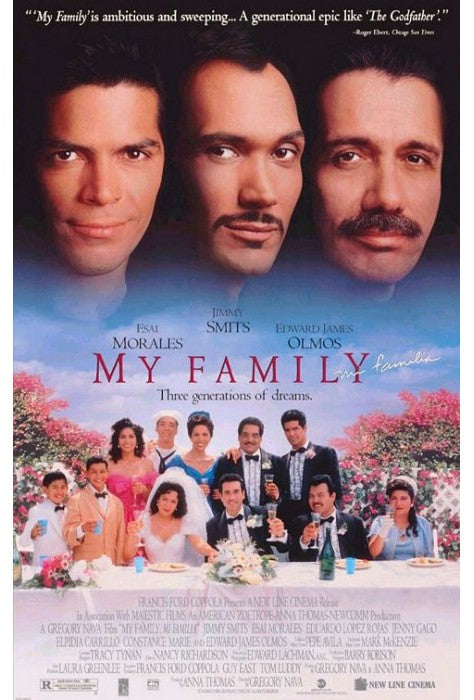

Jose Sanchez walks from Mexico to Los Angeles in 1926. He marries. He has children. His children have children. Gregory Nava's Mi Familia — narrated by Edward James Olmos — traces three generations of a Chicano family in East Los Angeles, and it does something most films about immigration don't: it keeps going long enough to show what actually happens across generations, not just arrival. That continuity is what makes this film extraordinary in a Spanish classroom. Students don't watch one story — they watch language itself change.
Mi Familia (Gregory Nava, 1995) spans sixty years of a single family's history, and across those sixty years, the Spanish shifts. The grandparents speak formal, traditional Mexican Spanish. The second generation code-switches — Spanish for family, English for the street. The third generation speaks primarily English but returns to Spanish for moments of emotion and crisis. Students hear language as a living thing that responds to circumstance — and that is one of the most important things a Spanish class can show them.
📬 Stay in the loop. New lessons added regularly — join the list to hear when your film is available.
Key Themes for the Classroom
- Immigration as family history — The Sanchez family's century-long journey is both the American dream and its complications. Ask: Se cumple el sueno americano para la familia Sanchez? What does each generation sacrifice for the next one?
- Language as identity marker — The shift from Spanish to English across generations is visible on screen. Ask: Que significa para la familia perder el espanol? Is it a loss, or a transformation? Students often have personal experience with exactly this question.
- Intergenerational change — The film covers sixty years. Ask: Como cambia la familia de una generacion a la otra? What persists? What is lost? What is invented?
- Violence, loss, and resilience — Jimmy's story — prison, loss, a son who doesn't know him — gives the film its grief. Ask: how does the film hold grief and joy in the same frame? What Spanish vocabulary carries that weight?
One Scene to Use
The deportation scene — Maria being deported while Jimmy is left behind as an infant — is one of the most viscerally unjust scenes in Chicano cinema. The language in this scene is institutional: the official register of deportation set against the personal language of a mother losing her child. After watching, ask students: Como trata el gobierno a Maria? And: what specific words or phrases mark the power difference between the official voice and Maria's voice? The contrast between register and humanity is a grammar lesson students won't forget.
One Low-Prep Classroom Activity
Students write a brief family history paragraph in Spanish — three generations, one family, one thing passed down through each generation. They can use a real family or invent one. The constraint: past tense throughout, third-person narration, and at least one moment where language itself changes between generations — a character who speaks Spanish, one who mixes, one who only uses Spanish in moments of feeling. The constraint produces generational Spanish narration with specific emotional detail.
The full Spanish lesson plan for Mi Familia is ready at filmarobics.com/products/mi-familia — $29.95. Covers vocabulary from the film's key scenes, grammar work on past tenses and direct object pronouns, cultural notes on Chicano identity and East Los Angeles, and writing tasks built around family, identity, and what endures.
Students walk away from Mi Familia having heard three generations of a family's Spanish evolve across sixty years — and having understood that a language can be both what you carry and what you let go.
The full Spanish lesson plan for Mi Familia is ready at filmarobics.com/products/mi-familia — $29.95.
📬 Stay in the loop. New lessons added regularly — join the list to hear when your film is available.
Students walk away from Mi Familia having heard three generations of a family's Spanish evolve across sixty years — and having understood that a language can be both what you carry and what you let go.