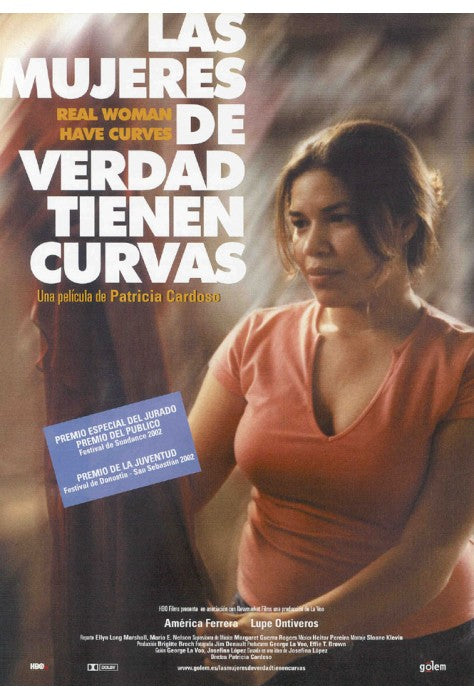

Ana García is eighteen, the first in her family likely to go to college, and her mother needs her in the garment factory right now. Patricia Cardoso's 2002 film — known in English as Real Women Have Curves — is one of the most precisely observed portraits of a Mexican-American daughter navigating first-generation ambition against the weight of family obligation. For a Spanish class in the United States, there is almost no better film: the Spanish is immediate and real, the situation is recognizable, and the argument at the center of the film is one your students are already having.
For Spanish students, the film offers East LA Spanish in the specific register of a multigenerational immigrant household: Ana's generation code-switches fluidly between English and Spanish; her mother's Spanish is the formal, conservative register of someone who built her identity in that language. Students hear the generational gap as a language gap, which makes the grammar lesson inseparable from the cultural one. The film is accessible at B1 level and has enough visual and contextual support to work even lower.
📬 Stay in the loop. New lessons added regularly — join the list to hear when your film is available.
Key Themes for the Classroom
- First-generation ambition — Ana wants to go to college. Her mother doesn't see why that matters more than family. Discussion: ¿Quién tiene razón, Ana o su mamá? What are both of them right about?
- Body image and cultural standards — The garment factory scenes, where the women talk about their bodies, are some of the most important in the film. Discussion: ¿Cómo define cada personaje la belleza? What does the title mean?
- Motherhood and sacrifice — Ana's mother sacrificed her own ambitions for her family. Discussion: ¿Le da eso a la mamá el derecho de decidir el futuro de Ana?
- Language and generational identity — Ana's English and her mother's Spanish are both complete, both right, and both marks of different kinds of belonging. Students can track the code-switching as a discussion prompt.
One Scene to Use
The factory scene where the women take off their clothes in the heat and Carmen and Ana argue about Ana's body — Carmen wanting to cover her, Ana refusing — is the film's thesis in four minutes. Underneath the argument about bodies is the argument about freedom, about what Ana is allowed to want. The Spanish in that scene is fast and honest and everything you'd want for an advanced listening exercise.
One Low-Prep Classroom Activity
Ask students to write two letters: one from Ana to a college admissions officer explaining who she is, and one from Carmen to her sister back in Mexico explaining what Ana is doing. Both letters are in Spanish, both are from people who love Ana, and they describe completely different people. Comparing them generates rich discussion about identity, perspective, and the language we use to tell our own story.
The full Spanish lesson plan for Mujeres de verdad tienen curvas is ready at filmarobics.com/products/teach-mujeres-de-verdad-tienen-curvas-spanish — $29.95.
Students finish this unit with vocabulary for identity, ambition, and family — and the question of whether wanting more for yourself is a betrayal or a gift.
The full Spanish lesson plan for Mujeres de verdad tienen curvas is ready at filmarobics.com/products/teach-mujeres-de-verdad-tienen-curvas-spanish — $29.95.
📬 Stay in the loop. New lessons added regularly — join the list to hear when your film is available.
Students finish this unit with vocabulary for identity, ambition, and family — and the question of whether wanting more for yourself is a betrayal or a gift.