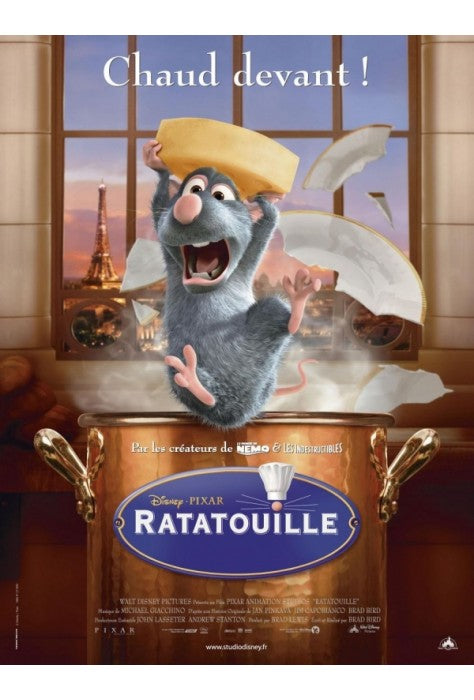
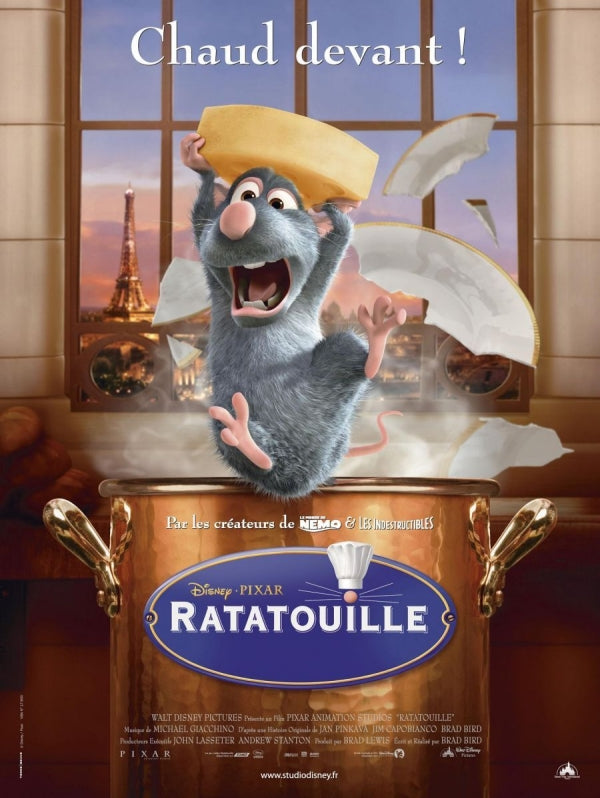
The food critic Anton Ego takes one bite of ratatouille — a peasant dish, a childhood dish — and is transported back to his mother's kitchen in a flash of sense memory so complete that Pixar animates it as a full color shift. Remy, a rat who has trained himself to cook, has made something so honest and so precise that it breaks through the most defended palate in Paris. Your French students don't need to know anything about France to understand that scene. But after this unit, they'll know quite a lot about France — and about what it means to do one thing extraordinarily well.
Ratatouille (Brad Bird, 2007) is set in Paris and saturated with French culinary vocabulary, restaurant culture, and the particular hierarchy of the French kitchen. The film's French proper nouns — La Ratatouille, Gusteau's, Linguini, Colette, Ego — are all pedagogically useful. The setting rewards cultural discussion about French food culture, the meaning of haute cuisine, and the French concept of terroir. And because the film is in English, teachers can use it for lower-level classes while still building cultural and culinary vocabulary.
📬 Stay in the loop. New lessons added regularly — join the list to hear when your film is available.
Key Themes for the Classroom
- "Anyone can cook" — and what that means: Gusteau's motto is democratizing. Ego's review argues the opposite — not anyone can cook, but a cook can come from anywhere. Ask students: which reading is right? How does French culture traditionally answer that question? (la tradition, l'excellence, le mérite, l'élitisme)
- The hierarchy of the French kitchen: Chef, sous-chef, saucier, garde-manger — the brigade system is rigid and old. Ask students where they see hierarchy working well and where it fails. What does Colette's experience as the only woman in the kitchen add to this discussion?
- Authenticity and deception: Remy controls Linguini from under his hat. The kitchen's success is built on a secret. Ask students: is it possible to be genuinely good at something through deception? What does French say about la tromperie vs. l'authenticité?
- Memory and taste: Ego's flashback is a Proustian moment — involuntary memory triggered by sensation. This is a chance to introduce students to Marcel Proust and the madeleine passage, and to discuss how taste, smell, and memory work in French culture and literature.
One Scene to Use
The final speech by Anton Ego — where he recants his negative review and reflects on what a critic is actually for — is one of the finest pieces of writing in any Pixar film. It works beautifully as a French reading and discussion exercise: translate key phrases, discuss the French vocabulary of critique and appreciation, and ask students: what does Ego understand at the end that he didn't understand at the beginning?
One Low-Prep Classroom Activity
French culinary vocabulary is some of the most useful vocabulary your students will ever learn — and it's almost entirely untranslatable, which means it's already French when they learn it. Give students a menu in French (use any Paris bistro menu available online) and have them identify ten items using vocabulary from the film. Then they each design their own one-course plat du jour — in French — explaining ingredients and preparation. The activity combines vocabulary, the imperative form, and French food culture in twenty minutes.
The full French lesson plan for Ratatouille is ready at filmarobics.com/products/ratatouille — $29.95.
📬 Stay in the loop. New lessons added regularly — join the list to hear when your film is available.
Students who work through this unit leave with the French of the kitchen — one of the most durable and internationally recognized vocabularies in the language — and with a cultural framework for understanding why France takes food seriously enough to make films about rats who can cook.