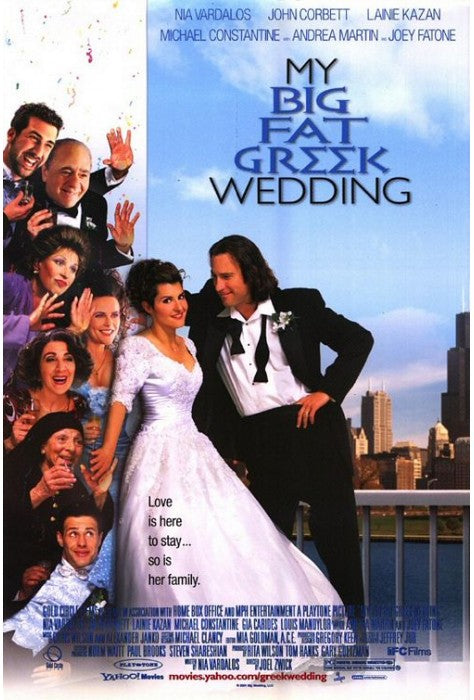
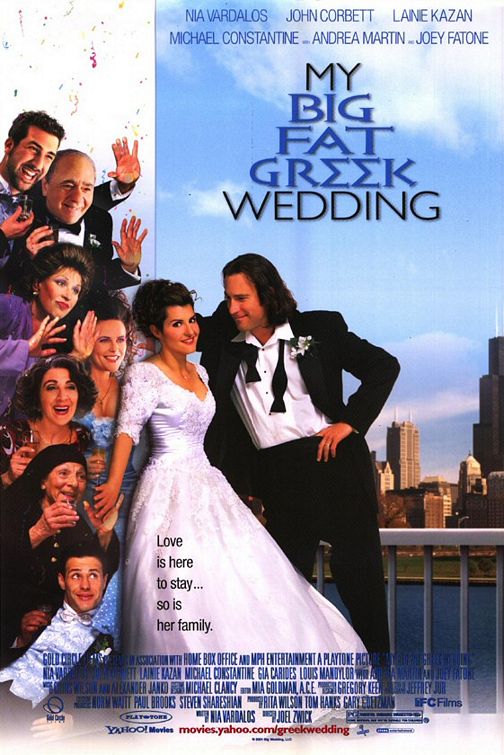
Toula Portokalos is thirty years old, Greek-American, working in her family's restaurant, and certain that her life is going nowhere. Then she falls in love with a non-Greek man, and her very large, very loud family has to decide what to do about it. My Big Fat Greek Wedding (2002) is the highest-grossing romantic comedy in history, and for an ESL class it is one of the most strategically useful films available: the English is clear, the humor is cultural and physical, and the film's central conflict — immigrant family culture meeting American individualism — is territory your students already know from their own lives.
For ESL students, the film offers something rare: an immigrant family portrayed with love rather than condescension. The Portokalos family's Greek-inflected English, their specific customs, and their absolute certainty about Greek cultural superiority is funny — but it's the kind of funny that students from immigrant families recognize as true. This film makes students who are navigating two cultures feel seen, which is a pedagogical gift that very few authentic texts can offer.
📬 Stay in the loop. New lessons added regularly — join the list to hear when your film is available.
Key Themes for the Classroom
- Immigrant identity and the second generation — Toula belongs to two cultures and is fully at home in neither. Discussion: How does Toula feel about being Greek-American? When does her identity feel like a resource and when does it feel like a burden?
- Family pressure and individual choice — The family has opinions about everything, including who Toula should marry. Discussion: What is the difference between family involvement and family control?
- Cultural humor and misunderstanding — The film is built on cross-cultural misreadings that are funny because they're true. Students can identify: which moments are funny because of a language difference? Which are funny because of a cultural assumption?
- Assimilation and preservation — The Portokalos family has kept Greek culture alive; Toula wants something they haven't given her. Discussion: What does assimilation cost? What does cultural preservation cost?
One Scene to Use
The dinner scene where Ian's quiet, reserved WASP parents meet the entire Portokalos family for the first time. The contrast between the two families' communication styles — silence vs. noise, restraint vs. expressiveness — is played for comedy, but the students' job is to identify the specific English each family is using. What vocabulary signals "American restraint"? What signals "Mediterranean warmth"? Both are real.
One Low-Prep Classroom Activity
Ask students to write the scene from Ian's perspective: the morning after he first goes to Toula's family home for dinner. What English does he use to describe what happened? Then ask a student from a similar family background to Toula to describe the same scene. Compare the two: what details change? This generates authentic, low-stakes speaking practice grounded in the film's world.
The full ESL lesson plan for My Big Fat Greek Wedding is ready at filmarobics.com/products/teach-culture-and-comedy-with-my-big-fat-greek-wedding — $29.95.
Students finish this unit with vocabulary for identity, family, and cultural navigation — and the recognition that being caught between two worlds is one of the oldest human stories.
The full ESL lesson plan for My Big Fat Greek Wedding is ready at filmarobics.com/products/teach-culture-and-comedy-with-my-big-fat-greek-wedding — $29.95.
📬 Stay in the loop. New lessons added regularly — join the list to hear when your film is available.
Students finish this unit with vocabulary for identity, family, and cultural navigation — and the recognition that being caught between two worlds is one of the oldest human stories.