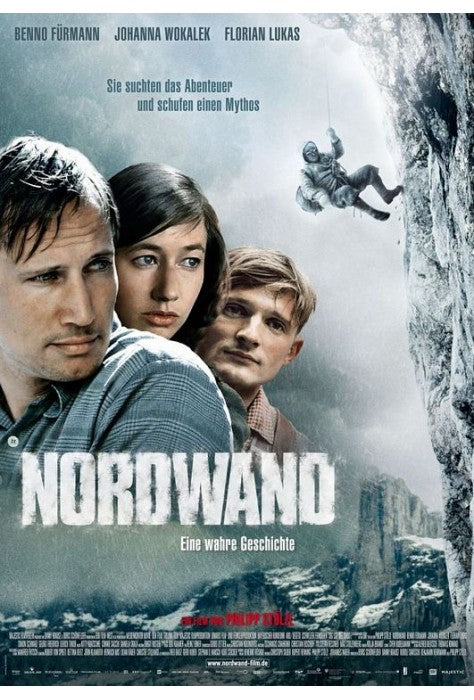
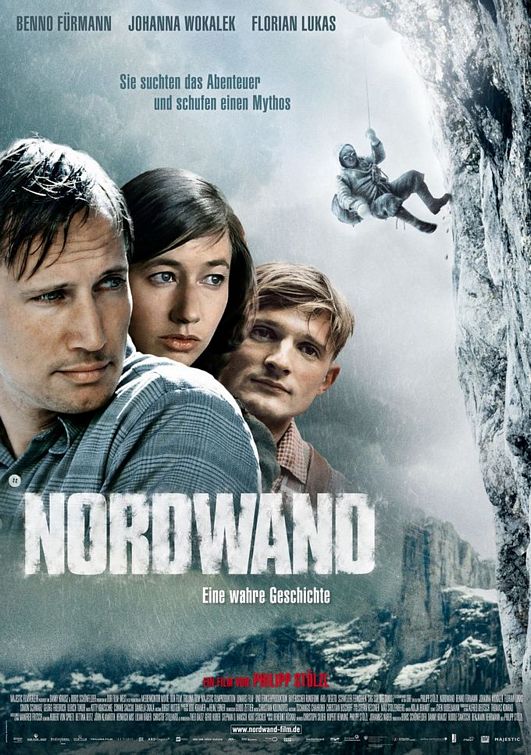
The north face of the Eiger — the most dangerous rock face in the Alps — was first climbed in 1938, and the competition between German and Austrian teams to be the first up it was explicitly political: the Nazis wanted the ascent as propaganda for the Berlin Olympics. Philipp Stölzl's 2008 film follows two German climbers, their former childhood friend Luise (now a journalist covering the attempt), and the slow, terrible process by which the mountain kills them. Nordwand is one of the most physically demanding films in the German catalog — almost unwatchably tense in its climbing sequences — and one of the most honest about the politics of achievement under fascism.
For German students, the film offers the German of 1938 in its full complexity: the official language of Nazi achievement, the private language of friendship and love, and the elemental language of people in extreme physical danger who have run out of everything except honesty. Students hear three completely different registers of German in the same film, and the historical context makes every word land with additional weight.
📬 Stay in the loop. New lessons added regularly — join the list to hear when your film is available.
Key Themes for the Classroom
- Courage and hubris — The climbers know the north face is dangerous. They climb it anyway. Ask: Was treibt Toni und Andi an? Is it courage, ambition, or something else?
- Propaganda and individual choice — The Nazi press wants to use the climb for propaganda. The climbers have their own reasons. Ask: Können persönliche Motive und politische Instrumentalisierung gleichzeitig existieren? Can you climb for yourself in a political context?
- Love and loss — Luise loves Toni. She watches through a telescope as the mountain takes him. Ask: Was sieht Luise, das die anderen Journalisten nicht sehen?
Scene to use: The summit camp scene the night before the final push — Toni and Andi in their sleeping bags, exhausted, talking about why they're doing this. The German in this scene is the German of complete honesty between two men who have stopped performing anything: no bravado, no politics, just two people trying to figure out what they want. Ask: Was wollen Toni und Andi wirklich? Are they the same answer?
Low-prep classroom activity: Students write a brief entry in German from Toni's climbing journal — the night before the final day. He must record the weather, his physical condition, one observation about Andi, and one thought about Luise. Past and present tense mixed, first person, and the spare, precise German of someone who has learned to say only what matters when everything is at stake.
What to listen for: The film's German tracks two registers in parallel: the clipped, technical German of the mountain face (where every word matters because words are all you have) and the elaborate, propaganda-inflected German of the journalists and Nazi officials below (where words are used to produce an impression rather than communicate a fact). Ask students to identify one exchange from the mountain and one from the base camp, and describe the difference. The contrast teaches students that German, like all languages, has a register for truth and a register for performance.
The full German lesson plan for Nordwand is ready at filmarobics.com/products/nordwand — $29.95.
Students walk away from Nordwand having heard German carry courage, ambition, and love in the specific register of people who are no longer performing anything — because the mountain has taken everything except what's real.
The full German lesson plan for Nordwand is ready at filmarobics.com/products/nordwand — $29.95.
📬 Stay in the loop. New lessons added regularly — join the list to hear when your film is available.
Students walk away from Nordwand having heard German carry courage, ambition, and love in the specific register of people who are no longer performing anything — because the mountain has taken everything except what's real.