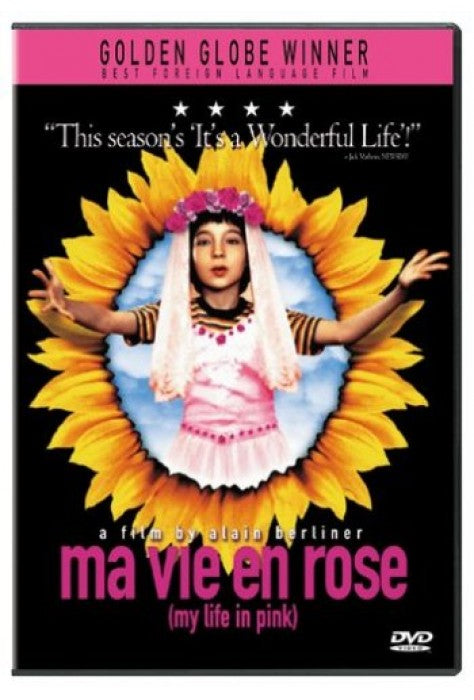

Ludovic is seven years old and has known for as long as she can remember that she is a girl. Her family has not known this. Neither has the neighborhood. Ma Vie en Rose (My Life in Pink) is a 1997 Belgian film by Alain Berliner about what happens when a child's certainty about her identity collides with a community's investment in her being something else — and it treats Ludovic with such complete respect and emotional precision that students who encounter it rarely forget it. For a French class, the film is also a portrait of Belgian suburban life that students rarely see: the French of the middle-class neighborhood, the dinner table, and the school playground.
For French students, the film offers contemporary Belgian French in a suburban family setting — the specific register of middle-class parents trying to manage a situation they don't know how to handle, alongside the completely different register of their seven-year-old, who hasn't learned yet to say one thing and mean another. The gap between adult circumlocution and Ludovic's direct speech is the film's central linguistic tension, and it's one of the most teachable features of any film in the catalog: students can literally track how adults talk around what they mean while children say exactly what they mean, and discuss why.
📬 Stay in the loop. New lessons added regularly — join the list to hear when your film is available.
Key Themes for the Classroom
- Identity and certainty — Ludovic knows who she is. Ask: Comment Ludovic exprime-t-elle son identité? And: What happens to that expression when the adults try to suppress it? Does the suppression work?
- Community and conformity — The neighborhood's reaction to Ludovic is the film's social argument. Ask: Pourquoi les voisins réagissent-ils si fortement? What are they actually afraid of?
- Parental love and social pressure — Ludovic's parents love her and can't protect her from the world. Ask: Comment les parents de Ludovic essaient-ils de l'aider? And: Is what they do enough? What would "enough" look like?
Scene to use: Ludovic explaining to her grandmother — the one adult who listens without agenda — exactly who she is and why. The French in this scene is a child's direct speech: short sentences, present tense, no qualification. The grandmother's response is the film's warmest moment. Ask: Comment la grand-mère répond-elle à Ludovic? And: Why does her response work when the other adults' don't? Students analyze the specific French vocabulary of acceptance versus redirection.
Low-prep classroom activity: Students write a brief letter in French from Ludovic to her classmates — explaining, simply and directly, who she is and what she wants them to understand. She must use the tu form for each classmate, say one true thing about herself, and end with one thing she would like from them. The task requires direct, first-person French in a child's confident voice — which is linguistically demanding precisely because it rules out the evasion that intermediate students often rely on.
The full French lesson plan for Ma Vie en Rose is ready at filmarobics.com/products/ma-vie-en-rose — $29.95.
Students walk away from Ma Vie en Rose having heard French carry a child's complete certainty about who she is — and having thought seriously about what a community owes the person who doesn't fit its expectations.
The full French lesson plan for Ma Vie en Rose is ready at filmarobics.com/products/ma-vie-en-rose — $29.95.
📬 Stay in the loop. New lessons added regularly — join the list to hear when your film is available.
Students walk away from Ma Vie en Rose having heard French carry a child's complete certainty about who she is — and having thought seriously about what a community owes the person who doesn't fit its expectations.