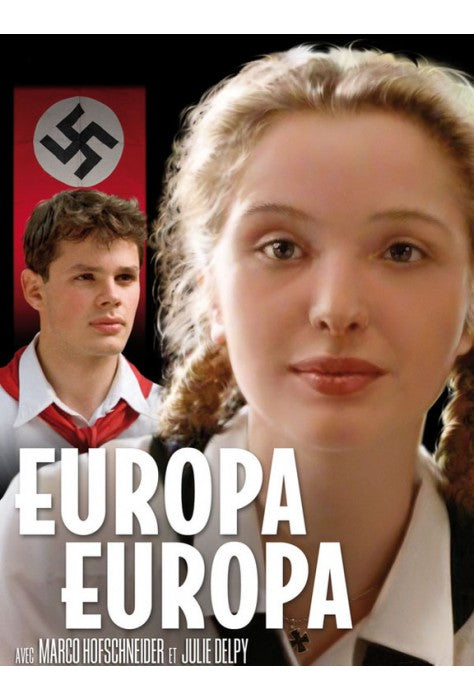
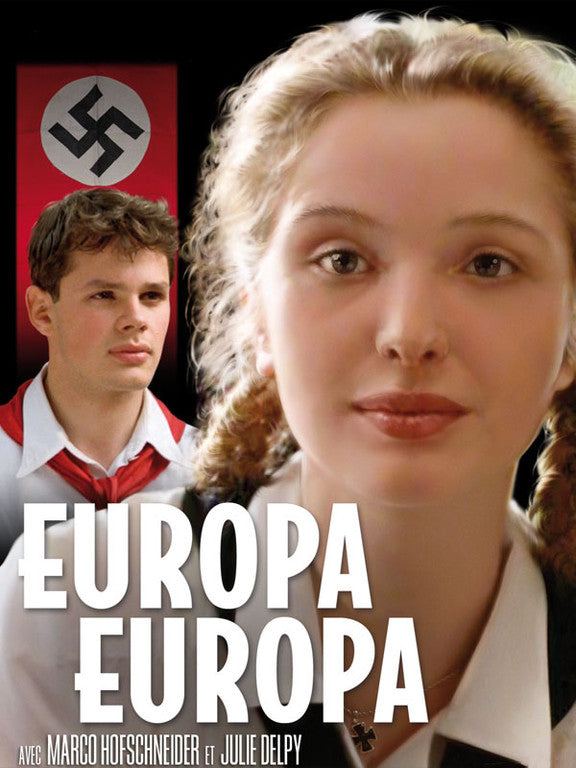
The premise of Europa, Europa is so extreme it has to be true — because it is. Solomon Perel is a young German-Jewish boy who, through a series of desperate improvisations during World War II, ends up masquerading as a German Aryan, enrolling in a Hitler Youth school, and surviving the war as someone he is not. The film — directed by Agnieszka Holland, based on Perel's memoir — is one of the most extraordinary true stories in German-language cinema, and it raises questions about identity, performance, and survival that students discuss for weeks.
For German students, the film is essential. It models the German of Nazi ideology with disturbing precision — the specific vocabulary of racial classification, military hierarchy, and ideological certainty — while simultaneously showing what it costs to perform that language when you are its target. Students hear German as both weapon and disguise, and that dual nature of the language is one of the most sophisticated sociolinguistic lessons available in film.
📬 Stay in the loop. New lessons added regularly — join the list to hear when your film is available.
Key Themes for the Classroom
- Identity and survival — Solomon performs being someone he isn't, so successfully that people believe him. Ask: Wann hört die Verkleidung auf und wird Wirklichkeit? When does a mask become a face?
- The language of ideology — The Hitler Youth school scenes show German being used as a tool of indoctrination. Students can identify the specific vocabulary and rhetorical structures of Nazi ideology in the language itself.
- Complicity and innocence — Solomon participates in things he doesn't believe to survive. The film doesn't condemn him, but it doesn't absolve him either. Ask: Ist Solomon mitschuldig?
Scene to use: Solomon's first days at the Hitler Youth school, where he has to perform ideological certainty about things that would get him killed if anyone knew who he was. The German in this scene is the precise language of conformity — agreement, enthusiasm, belonging — spoken by someone who understands exactly what it means and still can't say so. After watching, ask: Wie verändert sich Solomons Körpersprache, wenn er Deutsch spricht? The answer reveals how language and identity are embodied.
Low-prep classroom activity: Students write a brief diary entry in German from Solomon's perspective after his first week at the school — what he observed, what scared him, what surprised him, and one thing he caught himself believing for a moment. The constraint requires students to write in first person, past tense, with emotional honesty about the experience of inhabiting a language that isn't meant for you.
What to listen for: Solomon Perel survives the war by becoming Jupp — a German Hitler Youth. His German is perfect; his identity is entirely performed. Ask students to track the moments when Jupp's German falters — the hesitations, the near-slips, the careful overcorrections. Then: Was verrät Jupps Deutsch, auch wenn er es nicht will? The linguistic performance is also the film's moral argument: that identity can be performed in a language while remaining intact beneath it. Students who track the German understand the survival story at its most precise level.
The full German lesson plan for Europa, Europa is ready at filmarobics.com/products/europa-europa — $29.95.
Students walk away from Europa, Europa having encountered German used as both instrument of survival and instrument of persecution — which is one of the most important lessons a German class can teach.
The full German lesson plan for Europa, Europa is ready at filmarobics.com/products/europa-europa — $29.95.
📬 Stay in the loop. New lessons added regularly — join the list to hear when your film is available.
Students walk away from Europa, Europa having encountered German used as both instrument of survival and instrument of persecution — which is one of the most important lessons a German class can teach.