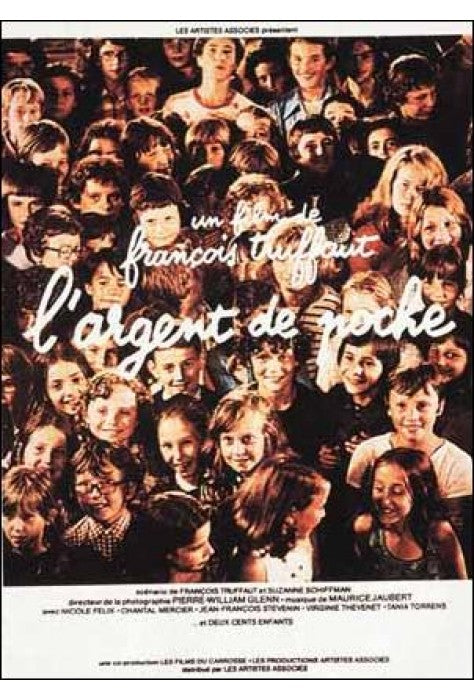
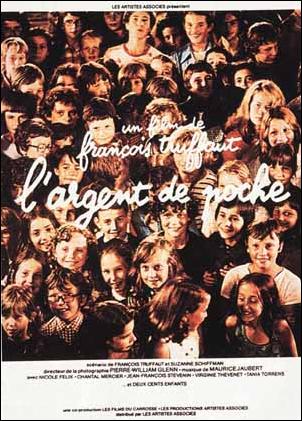
François Truffaut made L'Argent de Poche (Small Change) in 1976 as a love letter to childhood — not the sentimentalized version, but the real version, with its cruelties and freedoms and the way children absorb the world differently from adults. It's a film made of episodes rather than a single story: a summer in a French provincial town, a dozen children, and the interconnected moments that add up to something like a theory of how childhood works. For a French class, it is one of the most linguistically generous films in the catalog.
The French in L'Argent de Poche is the French of real children in a real small town — informal, energetic, regionally specific, and completely unselfconscious. Students who have been learning formal French in textbooks hear a completely different register: how French children actually speak, what slang sounds like in context, how French families negotiate dinner and television and pocket money. This is the French that makes students feel like they're inside a language rather than studying it from the outside.
📬 Stay in the loop. New lessons added regularly — join the list to hear when your film is available.
Key Themes for the Classroom
- Resilience and childhood — One of the film's episodes involves a child who falls from a window and is completely unharmed. Another involves a child from an abusive home who finally gets help. Ask: Comment les enfants s'en sortent-ils dans ce film? What do children have that adults have lost?
- Adult failures and childhood survival — The adults in the film range from wonderful to negligent. Ask: Quels adultes dans le film prennent bien soin des enfants? Which fail, and how?
- Provincial French life — The Thiers setting (a town in Auvergne) gives students access to small-town French culture — the school, the market, the cinema, the summer street life — that Paris-focused French education rarely reaches.
Scene to use: Julien's home visit from the teacher and social worker — the scene where it becomes clear that Julien's home life is far from the film's otherwise cheerful tone. The French in this scene is careful, official, and quietly devastating — the language of institutions recognizing a situation they should have noticed earlier. Ask: Qu'est-ce que ce moment révèle sur les adultes dans cette communauté?
Low-prep classroom activity: Students write a brief "summer diary entry" in French — as one of the film's children, describing their best day of that summer. Present or past tense, first person, and at least one adult who helped them and one adult who didn't. The task produces character-driven French writing with emotional specificity.
What to listen for: Truffaut films children talking to each other without adult supervision — which produces a French that adults almost never hear in French films: the specific rhythm of children at play, negotiating, teasing, comforting, and occasionally being genuinely cruel. Ask students to identify one scene where children are talking without an adult present and describe the French they use. Then: how is it different from how they talk to teachers, parents, or strangers? The register distinction is immediately apparent, and it teaches students something about French social language that most classroom materials never address.
The full French lesson plan for L'Argent de Poche is ready at filmarobics.com/products/argent-de-poche — $29.95.
Students walk away from L'Argent de Poche having heard the French that French children actually speak — in a summer that is both completely ordinary and, in Truffaut's hands, completely extraordinary.
The full French lesson plan for L'Argent de Poche is ready at filmarobics.com/products/argent-de-poche — $29.95.
📬 Stay in the loop. New lessons added regularly — join the list to hear when your film is available.
Students walk away from L'Argent de Poche having heard the French that French children actually speak — in a summer that is both completely ordinary and, in Truffaut's hands, completely extraordinary.