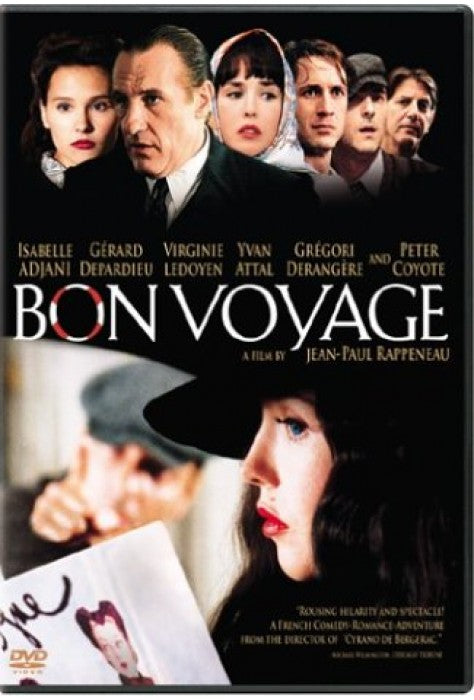

Paris, June 1940. The German army is three days away. The most famous actress in France — vain, brilliant, and morally flexible — is trying to leave the city in a chauffeured car. A physicist is trying to leave with a flask of heavy water that could determine the outcome of the war. A politician is trying to leave without anyone noticing what he's already done. And Jean-Etienne Beaumont, a young man who has just helped the actress escape from prison and is desperately in love with her, is trying to understand what any of it means. Bon Voyage is a French thriller disguised as a farce, and it is very funny until it suddenly isn't.
Bon Voyage (Jean-Paul Rappeneau, 2003) uses 1940s Parisian French — elegant, rapid, and morally compromised — in a plot that moves at screwball comedy pace. Students hear the French of urgency, romance, political expedience, and wartime fear in a single film. The historical context — the fall of France — is one that students rarely encounter through a French narrative perspective, and this film provides that perspective with intelligence and wit.
📬 Stay in the loop. New lessons added regularly — join the list to hear when your film is available.
Key Themes for the Classroom
- The fall of France: This is what June 1940 actually felt like from inside — not heroic resistance, but panic, selfishness, fleeing, and the scramble to protect what matters to you most. Ask students: what does this version of history say about how people actually behave when their world collapses?
- Celebrity and moral exemption: The actress believes her fame protects her from consequences. It mostly does. Ask students: what does French vocabulary say about the privileges of the famous? What is the word for impunity in French?
- Scientific knowledge as weapon: The heavy water flask — which actually existed — represents a moment when physics became the most important secret in the world. Ask students: what responsibility does a scientist have for what their knowledge enables?
One Scene to Use
The press conference scene — where the collaborationist politician gives a speech about France's dignity while French citizens flood out of Paris in terror behind him — is a precise depiction of how official language serves power. After watching, ask students to identify the French vocabulary of political dishonesty in the speech: l'honneur, la patrie, la confiance, le sacrifice. Then ask: what is each of these words doing in the speech? What work is the language being asked to perform?
One Low-Prep Classroom Activity
The film takes place over approximately three days in June 1940. Give students a timeline — June 10, 11, 12 — and ask them to place five scenes from the film in chronological order, writing one French sentence describing what happens at each point. The activity is sequence vocabulary (d'abord, ensuite, puis, finalement, le lendemain) embedded in historical narrative.
The full French lesson plan for Bon Voyage is ready at filmarobics.com/products/bon-voyage — $29.95.
📬 Stay in the loop. New lessons added regularly — join the list to hear when your film is available.
Students who work through this unit leave with the French of wartime moral compromise — the language as it sounds when everyone in the room is trying to survive and some of them are not being honest about the price.