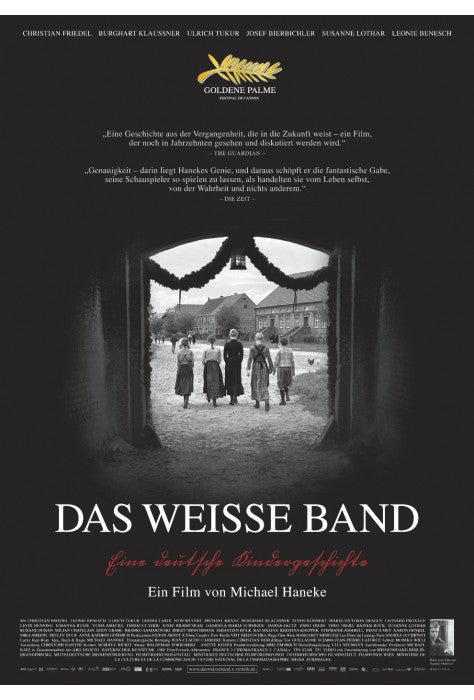

Michael Haneke makes films that don't let you look away — and Das Weiße Band (The White Ribbon) is his most chilling, because the violence is never shown directly. A small Protestant village in northern Germany, just before World War I. A series of seemingly accidental events that are not accidents. Children who may know more than they're saying. And a community of adults who enforce a moral order so rigid that what grows in its shadow becomes monstrous. The film won the Palme d'Or at Cannes. It belongs in an advanced German class.
For German students, the film offers something rare and important: sustained, literary German from a historical era, spoken in extreme emotional circumstances. The language of the village — formal, hierarchical, controlled — contrasts with what the images imply. Haneke uses that gap between what is said and what is happening as his primary tool, and students who track language carefully are rewarded with something like comprehension of what the film refuses to state directly.
📬 Stay in the loop. New lessons added regularly — join the list to hear when your film is available.
Key Themes for the Classroom
- Authoritarianism and its roots — The film is explicitly about how fascism grows in ordinary communities, through ordinary authority, in ordinary homes. The German vocabulary of discipline, punishment, and moral order is central. Ask: Wie benutzen die Erwachsenen Sprache, um Macht auszuüben?
- Silence as complicity — Nobody reports what they suspect. The community's silence is as much a subject of the film as the violence itself. Students encounter German as a language of knowing and not-saying.
- Childhood and innocence — The children of the village are simultaneously victims and perpetrators. That moral ambiguity is the film's engine and its most disturbing gift.
Scene to use: The pastor's punishment of his son for an unspecified transgression — the formal pronouncement of guilt, the controlled application of consequences, and the child's completely silent reception of it. The German here is ceremonial, deliberate, and terrifying precisely because of its correctness. After watching, ask: Was sagt dieser Dialog über die Bedeutung von Disziplin in dieser Gesellschaft? Students must analyze language as ideology, which is advanced work.
Low-prep classroom activity: Give students a short passage: a community notice from the village, written in formal German, announcing that an investigation into the recent incidents is underway. Students must identify: what is being said, what is being implied, and what is conspicuously absent. Then they rewrite it as an honest account of the same events. The gap between the two versions is the lesson.
What to listen for: Michael Haneke's German is stripped to its bones: declarative, formal, and shot through with the specific German of patriarchal authority. The pastor's German, the schoolmaster's German, the doctor's German are all versions of the same register — control through language. Against this, the children speak almost not at all. Ask students: Wer redet in diesem Film, und wer schweigt? The power map drawn from speech patterns is more accurate than any sociological description of the community Haneke is depicting.
The full German lesson plan for Das Weiße Band is ready at filmarobics.com/products/weisse-band — $29.95.
Students walk away from Das Weiße Band having encountered German as the language of institutional authority — and having thought seriously about what happens when that authority is beyond question.
The full German lesson plan for Das Weiße Band is ready at filmarobics.com/products/weisse-band — $29.95.
📬 Stay in the loop. New lessons added regularly — join the list to hear when your film is available.
Students walk away from Das Weiße Band having encountered German as the language of institutional authority — and having thought seriously about what happens when that authority is beyond question.