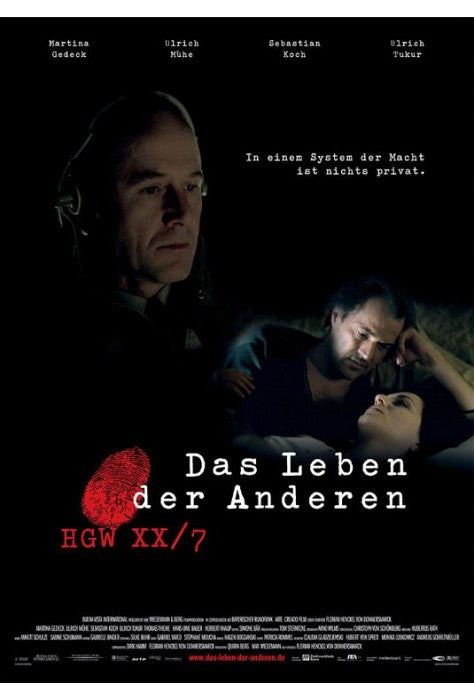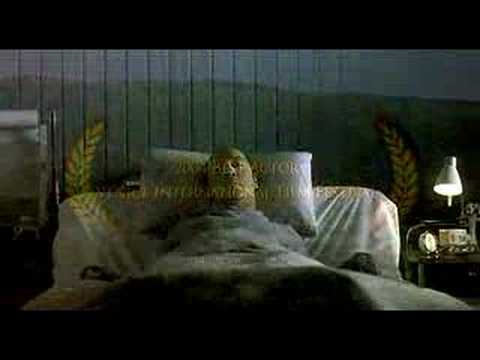
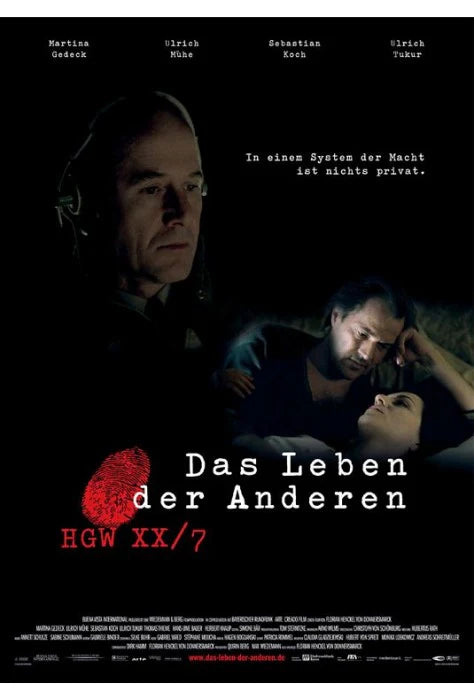
Captain Wiesler is a Stasi officer assigned to surveil Georg Dreyman, a playwright the state suspects of disloyalty. He sits in an attic apartment, headphones on, listening to every sound from the apartment below. At some point in the film — you'll know the moment when it comes — Wiesler makes a choice. A small one. A devastating one. And everything your students thought they knew about good people, bad systems, and the courage it takes to be decent collapses and reassembles into something more honest.
Das Leben der Anderen (Florian Henckel von Donnersmarck, 2006) is one of the finest German-language films ever made, and its language is exceptional for classroom use. The Stasi bureaucracy speaks in a particular kind of official German — cold, precise, euphemistic — that contrasts sharply with Dreyman and Christa's warmer, more literary register. Students learn to hear the difference between language used to control and language used to create. That's not just linguistics. That's how totalitarianism works.
📬 Stay in the loop. New lessons added regularly — join the list to hear when your film is available.
Key Themes for the Classroom
- Surveillance and humanity: Wiesler is excellent at his job — which means he is excellent at eliminating privacy. Ask students: what would you do differently if you knew someone was always listening? Then: what does it mean to live in a state built on that premise?
- Art under pressure: Dreyman is tolerated because he's internationally respected. The moment he becomes a liability, he's at risk. Ask students: what does art owe the state? What does the state owe art?
- The bureaucracy of evil: The Stasi files are meticulous, exhaustive, and morally empty. Discuss with students the German concept of Befehlsnotstand — the idea that following orders removes moral responsibility. Where does that argument fail?
- Redemption without absolution: Wiesler's act of conscience saves Dreyman but cannot undo what he's done. The film's final scene — Wiesler buying Dreyman's book, dedicated to him — is one of cinema's most moving endings. Ask students: can you redeem yourself without forgiveness? What German vocabulary exists for this kind of quiet reckoning?
One Scene to Use
The scene where Dreyman plays Beethoven's Sonate vom Guten Menschen ("Sonata for a Good Person") on his piano, and Wiesler listens upstairs with his eyes closed, is the film's pivot point. Wiesler asks his superior: "Can anyone who has heard this music, I mean really heard it, still be a bad person?" His superior doesn't understand the question. Use this scene to teach how German handles rhetorical questions and the difference between kann and dürfte in questions of moral possibility.
One Low-Prep Classroom Activity
Before watching, give students a list of Stasi surveillance vocabulary: Überwachung, Abhören, Bericht, Verdacht, Verrat, Schweigen, Akte, Spitzel. They predict the emotional tone of the film from the word list alone. After watching, they write: which word from the list would Wiesler most want erased from his record? Why? Two paragraphs, in German, due next class.
The full German lesson plan for Das Leben der Anderen is ready at filmarobics.com/products/das-leben-der-anderen — $29.95.
📬 Stay in the loop. New lessons added regularly — join the list to hear when your film is available.
Students who work through this unit leave understanding that German is not only the language of philosophy and poetry — it is also the language in which entire generations lived under a state that listened to everything they said.