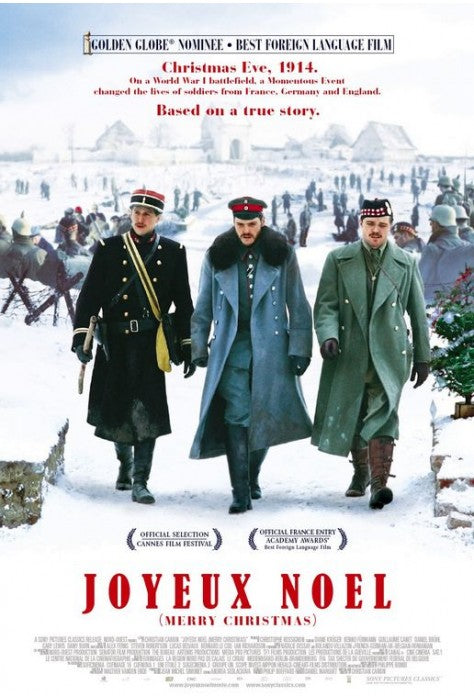
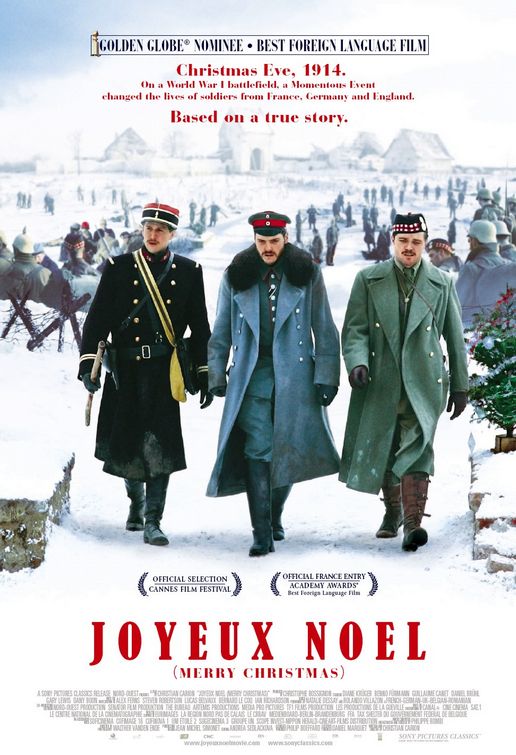
Joyeux Noël is built around one of the most extraordinary moments in modern history: Christmas Eve 1914, when German, French, and Scottish soldiers climbed out of their trenches, met in No Man's Land, and chose — briefly — to be human together. That moment is the lesson. Not as a feel-good story, but as a genuine historical rupture that raises hard questions about war, obedience, nationalism, and what soldiers owe the people who sent them to die.
For language teachers, the film has an additional advantage: it is genuinely multilingual. Characters speak German, French, and English across the same scenes. Students hear all three languages in context, often without subtitles, and track meaning through emotion and action. That is immersive language learning at its most natural.
📬 Stay in the loop. New lessons added regularly — join the list to hear when your film is available.
🇫🇷 Teach It in French
For French classes, Joyeux Noël provides something rare: historical weight paired with accessible spoken French. The French soldiers' dialogue is emotionally direct — grief, homesickness, and relief expressed plainly, without literary register. That plainness is pedagogically valuable. Students hear how real emotion sounds in French rather than the elevated prose of literary texts.
The scene to use: the truce scene itself, when the German tenor sings "Stille Nacht" from the trench and Scottish soldiers respond with bagpipes. French soldiers emerge. No words — then all words. The scene's vocabulary of hesitation and wonder is rich, and the moment a French soldier extends his hand to a German is one of the most teachable in film. Ask students: Qu'est-ce qui est plus fort — les ordres ou l'humanité? That question stays with a class.
The full French lesson plan for Joyeux Noël is at filmarobics.com/products/joyeux-noel — $29.95.
🇩🇪 Teach It in German
The German angle on Joyeux Noël is particularly powerful for history-conscious classes. The German characters — especially the operatic tenor Nikolaus Sprink and his civilian partner Anna — give students access to a WWI perspective that is rarely taught in anglophone classrooms. The vocabulary of guilt, duty, and loyalty (Pflicht, Schuld, Vaterland) appears organically in the German dialogue, with immediate emotional context that makes it stick.
The scene to use: Sprink's argument with his commanding officer after the truce, as German high command moves to punish the fraternizing soldiers. The dialogue is formal, tense, and loaded with the language of military hierarchy. Students who have watched the truce scene first feel the stakes immediately. Ask: Welche Wahl hat Sprink? What choices does he actually have? The answer requires subjunctive mood — perfect grammar instruction hiding inside a moral dilemma.
The full German lesson plan for Joyeux Noël is at filmarobics.com/products/joyeux-noel-german — $29.95.
📅 Teach It When It Counts
- December (before winter break): The Christmas Eve setting makes this the most natural December film in the FilmArobics catalog — and one of the most emotionally resonant ways to close a semester.
- November 11 (Armistice Day / Veterans Day): The film's WWI setting and its meditation on peace make it ideal for this date in any language class.
📬 Stay in the loop. New lessons added regularly — join the list to hear when your film is available.
Students walk away from Joyeux Noël having heard three languages in a single film and argued about a moral question that has no clean answer — which is exactly where language learning and critical thinking meet.