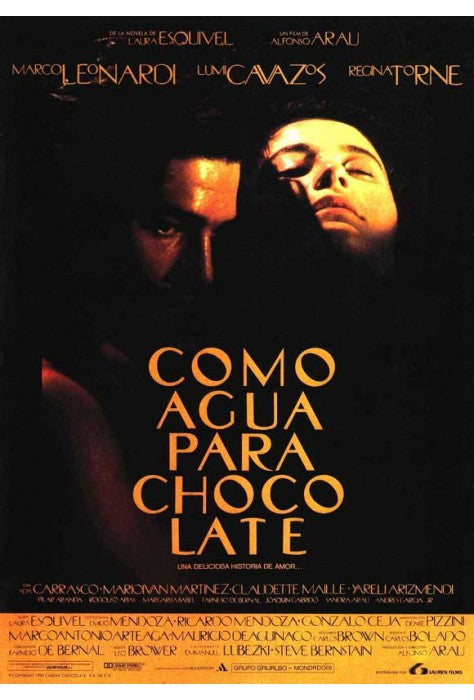
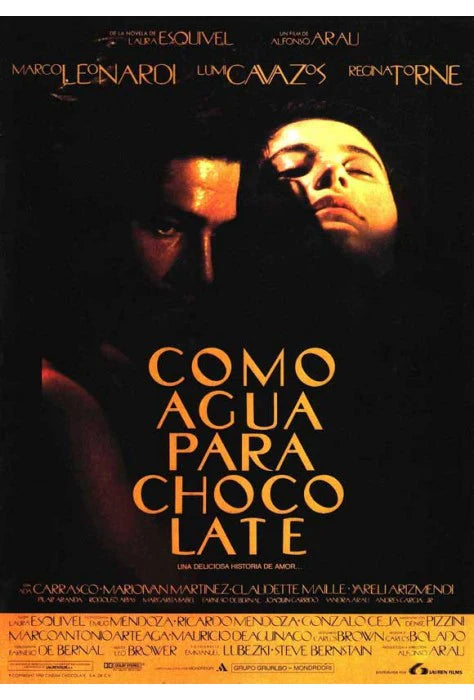
Tita cannot marry Pedro, the man she loves, because Mexican tradition requires the youngest daughter to stay home and care for her mother. So she cooks. And the emotions she cannot express in words enter the food she prepares and literally affect everyone who eats it: her tears in the wedding cake make the guests weep, her longing in the rose petal quail makes the wedding guests delirious with desire. Laura Esquivel's magical realism is not a literary device — it is the most honest description of what happens to feelings that have nowhere to go.
Como Agua Para Chocolate (Alfonso Arau, 1992) is set in northern Mexico during the Revolution and uses formal, traditional Mexican Spanish that is beautifully clear and culturally specific. The vocabulary of cooking, family hierarchy, and emotional repression are interwoven throughout. Students learn food vocabulary, traditional Mexican customs, and the grammar of obligation (tener que, deber, hay que) through a story that makes all three emotionally unavoidable.
📬 Stay in the loop. New lessons added regularly — join the list to hear when your film is available.
Key Themes for the Classroom
- Tradition and suffering: The tradition that prevents Tita from marrying is explained — it exists because someone was lonely and decided that's how it should be. Ask students: what traditions exist in their culture that exist mainly because they always have? What Spanish vocabulary describes this kind of inherited rule?
- The body's language: Tita's body says what she cannot say: she weeps, she sickens, she finally burns. Ask students: what does Spanish say about the relationship between emotion and the body? Vocabulary: el cuerpo, el alma, llorar, arder, sangrar, sentir.
- Mexican Revolution as backdrop: The Revolution is happening around Tita's family while they perform the rituals of domestic life as if nothing has changed. Discuss: what does it mean to maintain domestic order while history is breaking in?
- Magical realism as cultural mode: The film takes Tita's emotions seriously as physical forces. Ask students: what would have to be true about the world for this to be possible? What does Mexican culture say about the relationship between feeling and reality?
One Scene to Use
The rose petal quail sequence — where Tita cooks with roses Pedro gave her, and the dish she prepares sends every dinner guest into a state of erotic longing — is the film's most famous scene. After watching it, ask students to write, in Spanish, what each character at the table is experiencing. The exercise requires subjunctive, conditional, and body vocabulary — three grammatical registers in a single emotionally rich context.
One Low-Prep Classroom Activity
The film is structured as a cookbook — each chapter corresponds to a recipe. Give students a simple recipe in Spanish (you can find traditional Mexican recipes online easily) and ask them: what emotion would you cook into this dish if it would affect everyone who ate it? Write three sentences in Spanish describing the emotion and its effect. The activity is conditional grammar and emotional vocabulary via magical realism.
The full Spanish lesson plan for Como Agua Para Chocolate is ready at filmarobics.com/products/como-agua-para-chocolate — $29.95.
📬 Stay in the loop. New lessons added regularly — join the list to hear when your film is available.
Students who work through this unit leave with the Spanish of Mexican domestic life — its food, its traditions, its particular form of beautiful, costly love.