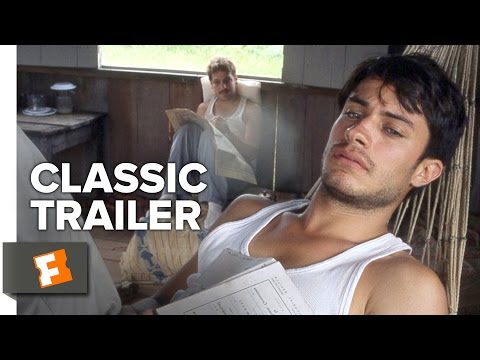

Carlos works in Los Angeles as an undocumented gardener, tending other people's beautiful lawns while his son Luis drifts toward gang affiliation in a city that doesn't offer him many other paths. When Carlos's truck — his entire livelihood — is stolen, the two of them set out across East LA to find it. Una Mejor Vida (2011) is a quiet film about a very specific kind of American story, and it gives a Spanish class something rare: contemporary immigrant Spanish, the Spanish of navigating two worlds simultaneously, spoken by characters who love each other but barely know how to say it.
For Spanish students, the film is exceptionally well-suited to American classrooms because it depicts a world many students already know — either from their own families or from their neighbors. The Spanish moves between Carlos's more formal, rural Mexican Spanish and Luis's English-dominant code-switching, and students hear the gap between the two as a measure of generational distance. Both registers are authentic and useful.
📬 Stay in the loop. New lessons added regularly — join the list to hear when your film is available.
Key Themes for the Classroom
- Father and son — Carlos and Luis barely speak. Discussion: ¿Por qué es tan difícil para Carlos y Luis comunicarse? What does each one want from the other that they can't ask for?
- Undocumented life — The film depicts the specific vulnerabilities and daily calculations of undocumented work. Discussion: ¿Qué sacrificios hace Carlos para que Luis tenga una mejor vida?
- The American Dream and its costs — Carlos came to the US for his son. Luis is becoming someone Carlos doesn't recognize. Discussion: ¿Es este el futuro que Carlos imaginó?
- Code-switching and identity — Luis's English-dominant Spanish signals where his identity is located. Students can track when he chooses Spanish and when he chooses English.
One Scene to Use
The scene where Carlos teaches Luis to prune roses — the one practical skill Carlos can pass down — is the film's most direct statement about fatherhood. Carlos knows one way to give Luis something lasting. Luis is barely paying attention. Have students watch it twice: once for what's said, once for what's happening underneath.
One Low-Prep Classroom Activity
Ask students to map the Spanish in the film: make two columns, one for Carlos's vocabulary and one for Luis's. What words appear in both? What words are exclusive to each? This vocabulary exercise doubles as a discussion about generational identity and language shift.
What to listen for: Carlos, the father, speaks the Spanish of a Mexican immigrant who has kept his language intact across decades in Los Angeles — formal, careful, and distinctly different from his son Luis's English-dominant bilingualism. The gap between their Spanishes is the film's emotional argument: Carlos is trying to give Luis a life in English, and in doing so has lost the Spanish that would connect them. Ask students: ¿Cómo hablan Carlos y Luis entre sí? The language pattern is the relationship pattern.
The full Spanish lesson plan for Una Mejor Vida is ready at filmarobics.com/products/teach-una-mejor-vida-spanish-class — $29.95.
Students finish this unit with vocabulary for immigration, family, and identity — and a clearer sense of what it costs to want a better life for someone else.
The full Spanish lesson plan for Una Mejor Vida is ready at filmarobics.com/products/teach-una-mejor-vida-spanish-class — $29.95.
📬 Stay in the loop. New lessons added regularly — join the list to hear when your film is available.
Students finish this unit with vocabulary for immigration, family, and identity — and a clearer sense of what it costs to want a better life for someone else.