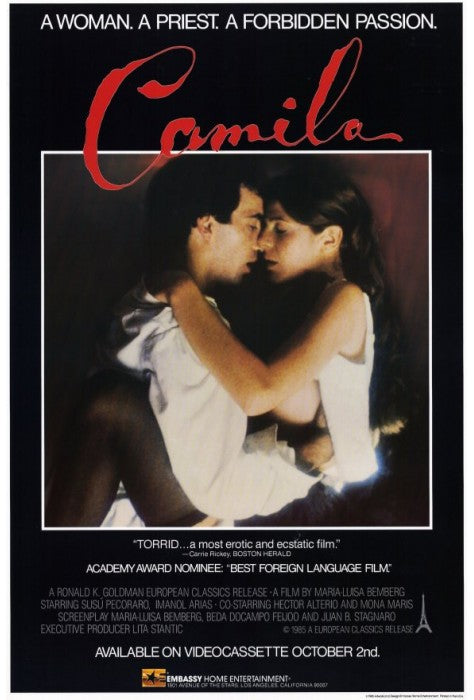

Argentina, 1847. Camila O'Gorman is from a wealthy Buenos Aires family, twenty-one years old, and completely in love with Ladislao Gutiérrez — a Jesuit priest. They elope. And in the Argentina of Juan Manuel de Rosas, that choice is not a romantic adventure: it is a political act, a religious crisis, and a death sentence. María Luisa Bemberg's film is one of the most powerful historical romances in the Spanish-language catalog, and its combination of genuine passion and political context makes it one of the most teachable.
For Spanish students, the 19th-century Argentine Spanish in the film is formal and historically inflected — the language of the upper classes during Rosas's dictatorship — but accessible enough that intermediate students can follow the emotional content clearly. The political vocabulary of Rosas's Argentina (unitarios, federales, the Mazorca) appears in context, and students encounter Argentine history through people who are living it.
📬 Stay in the loop. New lessons added regularly — join the list to hear when your film is available.
Key Themes for the Classroom
- Love against authority — Camila and Ladislao's love is transgressive at every level: class, religion, politics. Ask: ¿Qué regla rompen exactamente Camila y Ladislao? And: ¿Fue su amor una decisión valiente o irresponsable?
- Women and agency in 19th-century Argentina — Camila acts with remarkable autonomy for her time and place. Ask: ¿Qué puede hacer Camila que otras mujeres de su época no pueden? What gives her that freedom?
- Political violence and personal life — Rosas's regime enters the story in specific, lethal ways. Ask: ¿Cómo usa Rosas el caso de Camila para sus propios propósitos políticos?
Scene to use: Camila's confrontation with her father after the elopement is discovered — or more precisely, the family's response to the scandal before she and Ladislao are caught. The Argentine formal Spanish of family honor, shame, and political calculation is concentrated in these scenes. Ask: ¿Cómo habla el padre de Camila sobre su hija? What is he protecting — his daughter, his family, or himself?
Low-prep classroom activity: Students write a brief letter in Spanish — from Camila, to her father, explaining why she did what she did. She must use formal address (usted), at least one appeal to love, one acknowledgment of the consequences she understood, and one thing she doesn't regret. The constraint produces formal Spanish writing with genuine emotional stakes.
What to listen for: The Spanish of 19th-century Buenos Aires upper class is formal, elaborately courteous, and full of the vocabulary of honor and obligation that structured Argentine elite society under Rosas. Students should note how characters signal social hierarchy through address forms and sentence structure — and how Camila's speech, as the film progresses, becomes less formal and more personally honest. That linguistic arc from social performance to individual truth is the film's character development made audible in the Spanish itself.
What to listen for: The Spanish of 19th-century Buenos Aires upper class is formal, elaborately courteous, and full of the vocabulary of honor and obligation that structured Argentine elite society under Rosas. Students should note how characters signal social hierarchy through address forms and sentence structure — and how Camila's speech, as the film progresses, becomes less formal and more personally honest. That linguistic arc from social performance to individual truth is the film's character development made audible in the Spanish itself.
The full Spanish lesson plan for Camila is ready at filmarobics.com/products/camila — $29.95.
Students walk away from Camila having heard formal Argentine Spanish carry the weight of love, politics, and a woman who chose her own life over her society's approval — and having thought seriously about what that choice cost.
The full Spanish lesson plan for Camila is ready at filmarobics.com/products/camila — $29.95.
📬 Stay in the loop. New lessons added regularly — join the list to hear when your film is available.
Students walk away from Camila having heard formal Argentine Spanish carry the weight of love, politics, and a woman who chose her own life over her society's approval — and having thought seriously about what that choice cost.