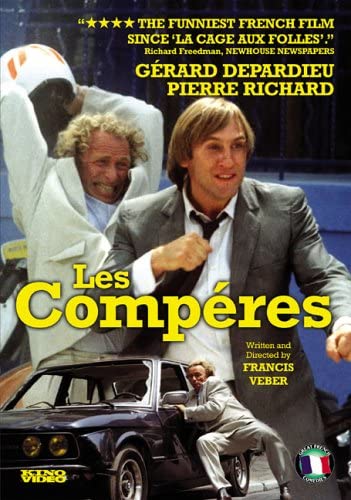

The setup of Les Compères is almost too good for a French class to resist. A woman sends two men — her current boyfriend and an ex — each individually convinced that he is the biological father of her runaway teenage son. They find the boy, they find each other, and they spend the rest of the film pretending they're not competing while competing furiously. Francis Veber, who wrote the film, is the master of the French farce, and this is one of his best — sharp, warm, and built entirely on the comedy of men who can't say what they actually mean.
The two leads — Gérard Depardieu and Pierre Richard — have opposite energies in French. Depardieu plays Lucas as blunt, physical, and loud; Richard plays Pignon as anxious, polite, and self-effacing. The contrast is a masterclass in French register and personality type. Students who have only heard formal classroom French laugh at Lucas's directness; students who have only heard French as polite social performance are surprised by Pignon's timidity. Both reactions are the lesson.
📬 Stay in the loop. New lessons added regularly — join the list to hear when your film is available.
Key Themes for the Classroom
- Masculine performance and vulnerability — Both men are performing confidence they don't entirely feel. The comedy comes from the gaps. Ask: Lequel des deux est plus honnête avec lui-même?
- What family means — Neither man is biologically the boy's father (probably). But both become invested in his wellbeing. The film asks: what makes a father? And it asks it in French, which matters.
- Unlikely friendship — Pignon and Lucas start as rivals and end as something like friends. The shift happens through shared difficulty, which is how the best French friendships in film always work.
Scene to use: Pignon and Lucas's first meeting in front of the boy's apartment building — each trying to appear casual, each failing completely. The French dialogue is fast, competitive, and full of indirect communication. Ask: Que veut vraiment dire chaque personnage dans cette scène? Students identify the gap between the surface language and the actual intention — indirect speech act analysis disguised as comedy.
Low-prep classroom activity: Give students a scenario: two people are competing for the same thing but pretending they're not. Have them write a short dialogue in French where every line means something different from what it says. They must include at least one euphemism, one indirect question, and one moment where someone says the opposite of what they mean. Veber has written this scene a dozen times — now students write their version.
What to listen for: Francis Veber's dialogue is a masterclass in comic French timing — each line sets up the next, and the comedy depends on exact word choice and exact delivery. The two male leads (Pierre Richard and Gérard Depardieu) have completely different comic registers: Pierre Richard's French is bumbling, sincere, and slightly off; Depardieu's is gruff, efficient, and direct. Their interactions produce comedy from register collision. Ask students to identify one exchange where the humor comes from the difference in how they speak rather than what they say. The analysis teaches French register distinction through laughter.
The full French lesson plan for Les Compères is ready at filmarobics.com/products/comperes — $29.95.
Students walk away from Les Compères having laughed hard at French and discovered that the language of comedy is also the language of everything people can't quite bring themselves to say directly.
The full French lesson plan for Les Compères is ready at filmarobics.com/products/comperes — $29.95.
📬 Stay in the loop. New lessons added regularly — join the list to hear when your film is available.
Students walk away from Les Compères having laughed hard at French and discovered that the language of comedy is also the language of everything people can't quite bring themselves to say directly.