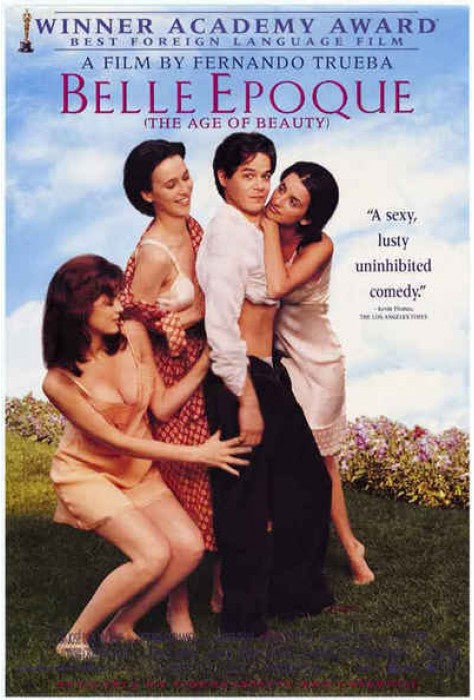
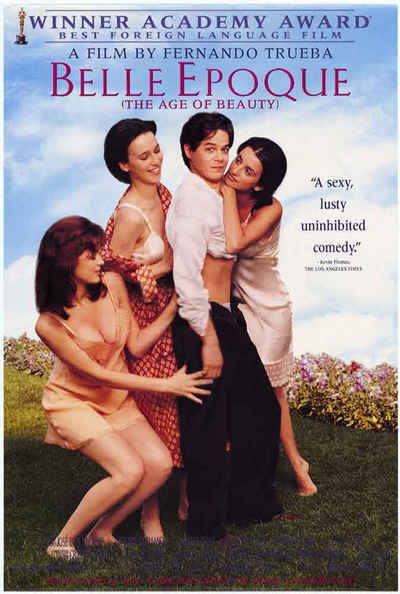
The year is 1931. Spain is on the cusp of the Second Republic. A young army deserter stumbles into a farmhouse in the countryside and meets an old anarchist painter with four beautiful daughters. What follows is one of the warmest, funniest, and most erotically self-aware films in the Spanish language — a comedy of manners, desire, and political hope that somehow makes the Spanish Republic feel like a living thing rather than a history lesson.
Belle Époque won the Academy Award for Best Foreign Language Film in 1994, and it earns it. For Spanish students, the film offers access to a historical moment — the brief, luminous years of the Republic before the Civil War — through characters who are alive in it rather than looking back at it. The Castilian Spanish is beautifully spoken, the register ranges from rustic to educated to militarily formal, and the humor is sophisticated without being inaccessible.
📬 Stay in the loop. New lessons added regularly — join the list to hear when your film is available.
Key Themes for the Classroom
- Political hope and historical irony — The characters live in a moment of possibility they don't know will end. Students who know what comes next feel the tragedy; students who don't can be let in gradually. Either way, the conversation is rich.
- Gender and desire — Each daughter represents a different kind of feminine autonomy for the era, and Fernando navigates them with a mixture of charm and helplessness. Ask: ¿Cuál de las hermanas tiene más libertad?
- The body and disguise — One of the film's most celebrated scenes involves Fernando dressed as a woman. In Spanish class, this scene opens a discussion of gender performance and language that is historically specific and immediately relevant.
Scene to use: Fernando's evening with Luz — the youngest daughter, the most modern, the most direct. Their conversation is frank in the way that only becomes possible at night, in a farmhouse, when nobody is watching. The Spanish is relaxed, intimate, and completely contemporary in feeling despite the period setting. Ask: ¿Cómo sabe Fernando que esta conversación es diferente? The answer is in the register shift.
Low-prep classroom activity: Have students write a brief "letter from 1931" in Spanish — a character in the film writing to someone they trust, describing what they hope Spain will become. They must use the future tense, at least one political term from the film's era (República, libertad, igualdad), and one personal hope alongside the political one.
📅 Teach it when it counts: April 14 is the anniversary of the proclamation of the Spanish Second Republic in 1931 — the historical moment the film depicts with such warmth. Teaching Belle Époque in mid-April gives students a specific historical anchor and situates the film's optimism in its real context: Spain in spring 1931, before anyone knew what was coming. The contrast between the film's happiness and the historical knowledge students bring to it is itself a lesson in how we relate to history's lost possibilities.
The full Spanish lesson plan for Belle Époque is ready at filmarobics.com/products/belle-epoque — $29.95.
Students walk away from Belle Époque with the Spanish to talk about freedom, desire, and historical possibility — in the language of a moment that couldn't quite hold all of it.
The full Spanish lesson plan for Belle Époque is ready at filmarobics.com/products/belle-epoque — $29.95.
📬 Stay in the loop. New lessons added regularly — join the list to hear when your film is available.
Students walk away from Belle Époque with the Spanish to talk about freedom, desire, and historical possibility — in the language of a moment that couldn't quite hold all of it.