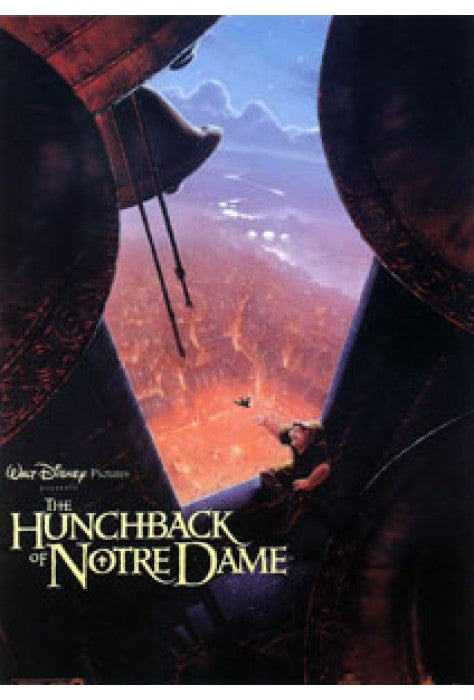

Victor Hugo knew what he was doing. The Hunchback of Notre Dame is not a children's story dressed up as a film — it's a story about who gets to be seen, who gets to belong, and what a society owes the people it has decided to ignore. The animated version carries that weight surprisingly well, and in a language class, that weight generates real conversation. Students don't need prompting. They come to it.
📬 Stay in the loop. New lessons added regularly — join the list to hear when your film is available.
🇪🇸 Teach It in Spanish — El Jorobado de Notre Dame
The Spanish dub of El Jorobado de Notre Dame makes Frollo's villainy immediately legible — his language is formal, legalistic, and cold, contrasting sharply with Quasimodo's warmer, more hesitant speech. For Spanish students, that contrast is a direct lesson in how register encodes power. Frollo says what he wants to say with complete confidence; Quasimodo negotiates permission. Students hear it even if they can't name it yet.
The scene to use: Quasimodo's first appearance at the Festival of Fools, when the crowd celebrates him before turning on him. The scene moves fast — celebration, mockery, shame, intervention — and the vocabulary of social acceptance and rejection lands in quick succession. Ask students: ¿Cómo cambia la actitud de la multitud? Tracking that shift requires attention to verbs of emotion and social behavior in Spanish, with context that makes every word memorable.
The full Spanish lesson plan for El Jorobado de Notre Dame is at filmarobics.com/products/jorobado-de-notre-dame — $29.95.
🇫🇷 Teach It in French — Le Bossu de Notre Dame
Teaching this film in French adds a layer the English version can't quite capture: Notre Dame is real, Paris is real, and Hugo is French. Students who have seen Paris or studied French history feel the connection immediately — and students who haven't begin to understand why Paris occupies the cultural position it does. The French dub is energetic and well-voiced, and the cathedral itself becomes a character that students want to understand.
The scene to use: the "Out There" sequence, where Quasimodo looks out from the bell tower over the city he's never been allowed to enter. In French, the vocabulary of longing, freedom, and restriction is particularly rich — subjunctive mood used naturally in the context of wishes and fears. Ask: Qu'est-ce que Quasimodo veut vraiment? and then: Qu'est-ce qui l'en empêche? Two questions that drive grammar and character simultaneously.
The full French lesson plan for Le Bossu de Notre Dame is at filmarobics.com/products/bossu-de-notre-dame — $29.95.
📅 Teach It When It Counts
- Social justice units (any semester): The film's central argument — that exclusion is a choice a society makes, not a natural fact — generates immediate student engagement and genuine debate.
- Medieval France / Paris units (French): Pairing this film with any study of French Gothic architecture or the Romantics puts Notre Dame in context students won't forget.
📬 Stay in the loop. New lessons added regularly — join the list to hear when your film is available.
Students leave having heard the language of belonging and exclusion in Spanish or French — in the voice of a character who asked for nothing more than to be seen.