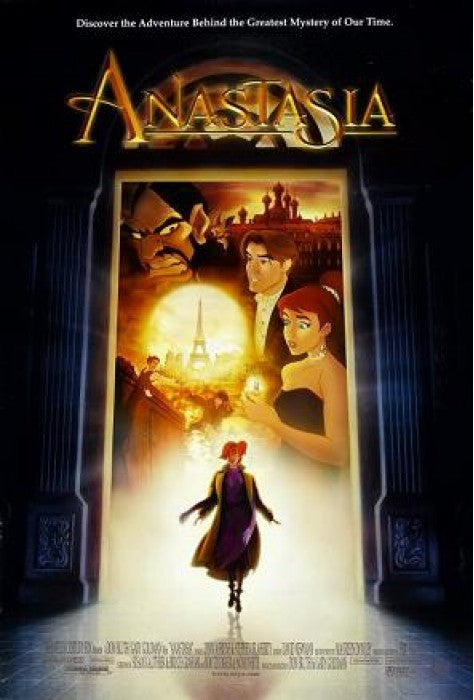
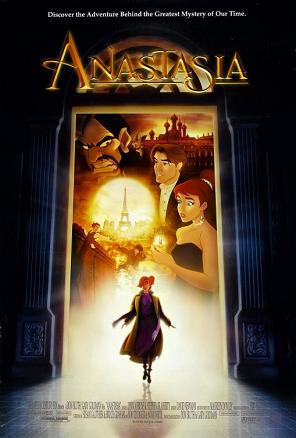
The myth of Anastasia — the lost Romanov daughter who may have survived — is one of the great romantic historical legends, and the animated version handles it with surprising sophistication for a children's film. Anastasia is a young woman with no memory of her past, a street-smart survival instinct, and a group of charming con men who want to exploit her resemblance to the missing princess. What makes the film teachable is that it's fundamentally about identity: who gets to tell you who you are, and what happens when the answer you're given doesn't fit. It's also a film that ends in Paris — which gives French students an anchor they recognize before the language begins.
For French students, the Don Bluth/Fox animated Anastasia has a real pedagogical advantage: Paris is the destination, and the Paris sequences use the French of landmarks, boulevards, and romantic recognition. The French dub is clear and well-paced, appropriate for intermediate students who need accessible spoken French with high emotional engagement. The villain Rasputin provides comic-dramatic contrast, and his scenes use more theatrical, elevated register that students can explicitly contrast with Anya's street French. The film covers three linguistic registers naturally: the imperial Russian past (formal, distant), the orphanage-and-street present (practical, direct), and the Parisian climax (romantic, descriptive).
📬 Stay in the loop. New lessons added regularly — join the list to hear when your film is available.
Key Themes for the Classroom
- Memory and identity — Anya doesn't know who she is. The film asks: can you be yourself if you don't know your past? Ask: Est-ce qu'on peut choisir qui on est, même sans mémoire?
- Authenticity and performance — Dmitri trains Anya to play Anastasia. She turns out to be Anastasia. Ask: À partir de quel moment Anya ne joue-t-elle plus un rôle? And: what is the difference between becoming someone and remembering who you were?
- Home and belonging — Anya's search for family ends unexpectedly. Ask: Où est chez elle, à la fin? What does "home" mean when your birth family is gone and you've built yourself from nothing?
Scene to use: Anastasia's arrival in Paris and her recognition of it — the city she half-remembers from childhood. The French in this scene is dreamy and descriptive, suffused with the vocabulary of recognition and beauty: je me souviens, c'est comme dans un rêve, quelque chose qui me rappelle... Ask: Quels mots utilise Anya pour décrire Paris? Students list the vocabulary of visual description and emotional recognition simultaneously. Then: which words are about the city, and which are about herself?
Low-prep classroom activity: Students write a short monologue in French from Anya's perspective — the first night in Paris, after she has begun to believe her own past might be real. She must describe what she sees, what she remembers, and one thing she's afraid to hope for. Future and conditional mood for the hopes; imparfait for the memories. The grammar is embedded in the emotional logic: memory goes in imparfait because it's uncertain; hope goes in conditional because it's not yet real. Students who understand that use the tenses correctly without thinking about rules.
The full French lesson plan for Anastasia is ready at filmarobics.com/products/anastasia — $29.95.
Students walk away from Anastasia having practiced French through a story about a woman reclaiming a self that history tried to erase — and having thought about what identity means when memory is the only evidence you have.
The full French lesson plan for Anastasia is ready at filmarobics.com/products/anastasia — $29.95.
📬 Stay in the loop. New lessons added regularly — join the list to hear when your film is available.
Students walk away from Anastasia having practiced French through a story about a woman reclaiming a self that history tried to erase — and having thought about what identity means when memory is the only evidence you have.