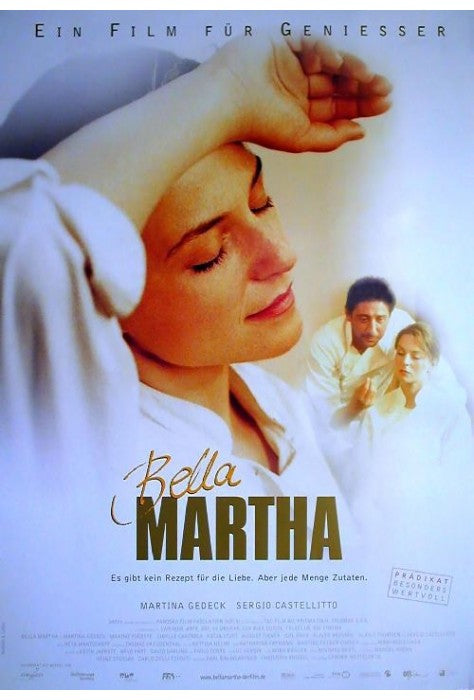
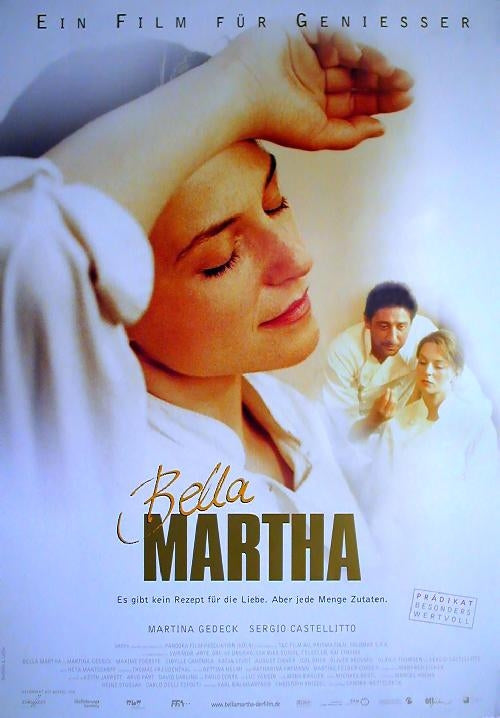
Martha is a chef. Not a good chef — an extraordinary chef, the kind who can make a guest cry by describing what he's about to eat. She is also entirely alone, because the intensity she brings to the kitchen leaves nothing for the rest of her life. Then her sister dies, her niece Lina arrives, and an Italian sous-chef named Mario is hired over her head. Bella Martha (Mostly Martha) is a German film about control, grief, and the specific way that extremely competent people fall apart when the thing they can't control arrives.
For German students, the film is immediately accessible. The contemporary Hamburg German is warm, urban, and clear; the food vocabulary is specific and learnable; and the contrast between Martha's controlled, precise German and Mario's warmer, more emotionally direct Italian-accented German gives students immediate register variation in a completely naturalistic context. The film is also one of the few in the German catalog that is genuinely light — it's a romantic comedy that earns its warmth.
📬 Stay in the loop. New lessons added regularly — join the list to hear when your film is available.
Key Themes for the Classroom
- Control and surrender — Martha's need for control is the film's engine. Ask: Warum braucht Martha so viel Kontrolle? And then: Was verändert sich, als sie Kontrolle abgibt?
- Grief and displacement — Martha channels her grief for her sister into her relationship with Lina, which doesn't work as planned. Ask: Wie versucht Martha, ihren Verlust zu verarbeiten?
- Food as language — Martha expresses herself through cooking in the way other characters express themselves through speech. Ask: Was sagt Martha mit ihren Gerichten, das sie mit Worten nicht sagen kann?
Scene to use: Martha cooking a meal for Lina late at night — the niece who won't eat anything — and Lina finally eating, one bite at a time, while Martha watches. The German in this scene is almost wordless; the communication is entirely through food. But when Lina does speak, her sentences are short, honest, and devastating. Ask: Wie kommunizieren Martha und Lina in dieser Szene ohne zu reden?
Low-prep classroom activity: Students write a brief restaurant review in German — from one of Martha's regulars, describing a meal she made for them. The review must mention at least three dishes using German food vocabulary, one thing the experience made them feel, and one observation about the chef herself. The task produces descriptive German writing with sensory precision.
What to listen for: The film makes the cultural contrast explicit through language: Martha's German is controlled, precise, and efficient — the German of someone who runs a kitchen through clarity. Mario's Italian is warmer, more associative, more comfortable with ambiguity. When they interact, the two registers produce comedy and eventually connection. Ask students to find one scene where Martha and Mario are saying the same thing in completely different registers and describe the difference in German. The translation of register difference into language about language is a genuinely advanced task.
The full German lesson plan for Bella Martha is ready at filmarobics.com/products/bella-martha — $29.95.
Students walk away from Bella Martha having heard German spoken by someone who communicates better with food than with words — and having learned that surrender and control sound very different in any language.
The full German lesson plan for Bella Martha is ready at filmarobics.com/products/bella-martha — $29.95.
📬 Stay in the loop. New lessons added regularly — join the list to hear when your film is available.
Students walk away from Bella Martha having heard German spoken by someone who communicates better with food than with words — and having learned that surrender and control sound very different in any language.