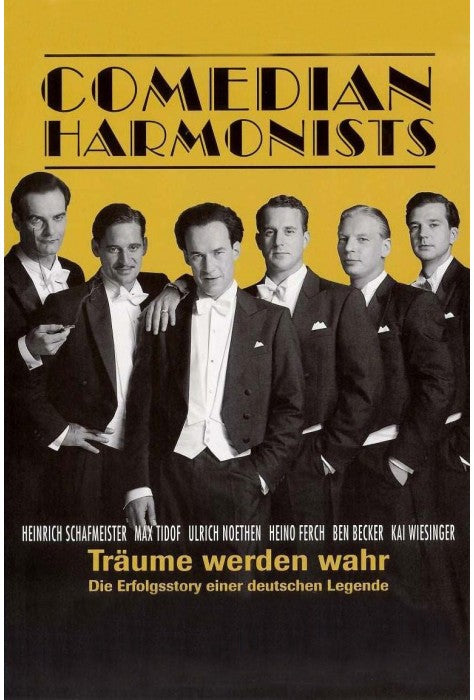

The Comedian Harmonists were real: six German singers — four Christian, two Jewish — who became the most popular vocal group in the Weimar Republic between 1927 and 1934. Their harmonies were extraordinary; their act was warm, witty, and completely beloved. And then the Nazis came to power, and the group's Jewish members couldn't perform anymore, and one of the great collaborations in German cultural history ended because the state decided who was allowed to make music. Joseph Vilsmaier's 1997 biopic recreates that story with the care it deserves — and for a German class, it provides access to the Weimar period, to the music that defined it, and to the specific German cultural moment when everything became political.
For German students, the film's language is Weimar-era German: the formal diction of concert halls and newspaper reviews, the informal speech of backstage camaraderie, and the increasingly menacing language of political meetings that intrude on both. The contrast between the group's private warmth and the public language of rising fascism is explicit and audible. Students hear German as a cultural medium — music, entertainment, commerce — and then hear it being weaponized against people who made that culture. The music itself is part of the lesson: the Comedian Harmonists sang in German, and their songs are still beautiful and still teachable.
📬 Stay in the loop. New lessons added regularly — join the list to hear when your film is available.
Key Themes for the Classroom
- Art and politics — The group tries to stay above politics while politics dismantles them. Ask: Glauben die Harmonists, dass Musik politisch neutral sein kann? And: is it possible to separate art from the political conditions that make it?
- Friendship across difference — Jewish and Christian members built something extraordinary together. Ask: Was verbindet die Mitglieder der Gruppe? What does their friendship make possible, and what can't it protect against?
- The ordinary mechanism of exclusion — The Jewish members aren't arrested; they're just not allowed to perform. Ask: Wie wird die Ausgrenzung in der Öffentlichkeit dargestellt? Students examine how discrimination operates through bureaucratic language and official procedure.
Scene to use: The group's final performance together — knowing it's the last — before the Jewish members can no longer appear on stage. The scene plays without melodrama. The music is beautiful; the ending is quiet; the audience in the film doesn't know what the audience watching the film knows. Ask: Was weiß das Filmpublikum, was das Konzertsaalpublikum nicht weiß? Students discuss dramatic irony in German.
Low-prep classroom activity: Students listen to one Comedian Harmonists song — "Veronika, der Lenz ist da" works well — and write three sentences in German: one about what the song sounds like, one about what the words mean, and one about what it means that this song was made by people who would soon be separated. The three-sentence constraint forces students to move from description to analysis to reflection, all in German.
The full German lesson plan for Comedian Harmonists is ready at filmarobics.com/products/comedian-harmonists — $29.95.
Students walk away from Comedian Harmonists having heard the Weimar Republic sing — and having understood, specifically and permanently, that culture is never separate from the political conditions that make it possible.
The full German lesson plan for Comedian Harmonists is ready at filmarobics.com/products/comedian-harmonists — $29.95.
📬 Stay in the loop. New lessons added regularly — join the list to hear when your film is available.
Students walk away from Comedian Harmonists having heard the Weimar Republic sing — and having understood, specifically and permanently, that culture is never separate from the political conditions that make it possible.