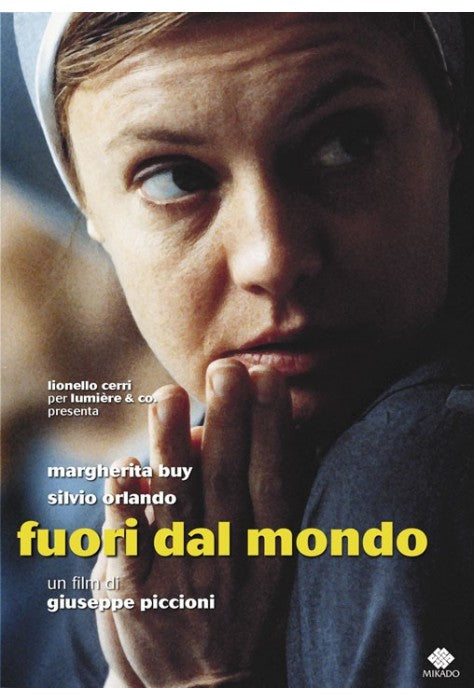
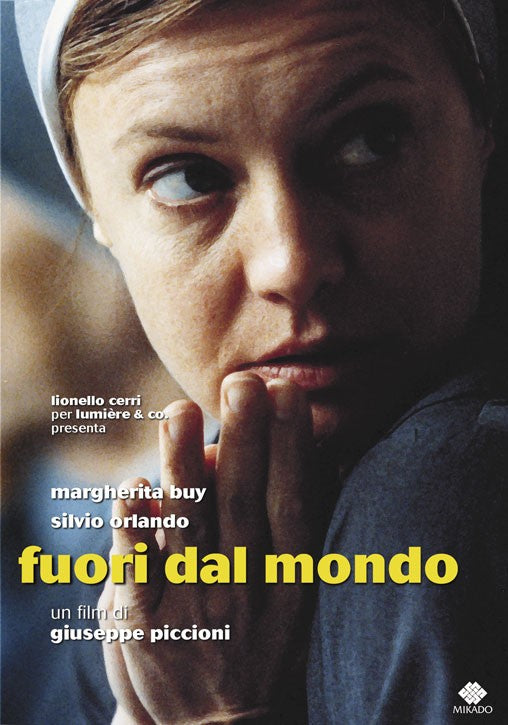
Italian cinema has a gift for the unexpected friendship — the pairing that shouldn't work and then does, with such specificity that you forget to be surprised. Fuori dal Mondo (Not of This World, 1999) is a fine example. Directed by Giuseppe Piccioni, it follows a nun who discovers an abandoned baby and, while searching for its parents, becomes tangled in the life of Ernesto, an absent-minded dry cleaner who is the only lead she has. What begins as investigation becomes, quietly, a story about two people who have each chosen a life that excludes things they didn't know they needed. For an Italian class, it is one of the most elegant portraits of everyday Milanese life available — warm, specific, and funny in the way that Italian daily life is funny.
For Italian students, the film's language is contemporary Milan Italian — clean, warm, and full of the rhythms of everyday spoken Italian. Suor Caterina's careful, formal Italian contrasts with Ernesto's distracted, self-interrupting speech, and the gap between them is part of the film's humor and its heart. Students hear two registers of Italian in genuine emotional context throughout: the Italian of the convent (careful, formal, measured) and the Italian of the dry-cleaning shop (provisional, associative, often incomplete). The contrast is entirely natural and completely teachable as an example of register differentiation in contemporary Italian.
📬 Stay in the loop. New lessons added regularly — join the list to hear when your film is available.
Key Themes for the Classroom
- Vocation and doubt — Suor Caterina is about to take her final vows when this happens. The film asks — gently, without melodrama — whether she's certain. Ask: Cosa vuole veramente Suor Caterina? Students debate whether doubt before a commitment is a warning sign or a necessary part of choosing.
- Unexpected connection — Neither character is looking for a friend. The connection that develops between them is tentative, indirect, and completely believable. The vocabulary of approaching and retreating — offering and declining, asking and deflecting — is everywhere and explicitly teachable as pragmatic Italian.
- Responsibility and abandonment — The abandoned baby is the film's moral center. Who left it, and why, and what should be done? These questions run throughout and give students real ethical material to engage with in Italian, covering topics that generate genuine disagreement.
Scene to use: Suor Caterina and Ernesto in the dry-cleaning shop, when they realize they need each other's help but can't quite say so. The Italian is full of indirect speech acts — statements that function as requests, questions that function as invitations. Ask students: Cosa chiede veramente Suor Caterina? Students must identify the speech act under the surface language. Then: how would you say this directly? Students write the direct version and compare it with the indirect version — a genuine pragmatics exercise in Italian.
Low-prep classroom activity: Students write a brief dialogue in Italian between two people who need something from each other but can't quite ask directly. One character should be formal, one more casual. Each must make one request indirectly, and each must respond without fully acknowledging what was asked. The constraint produces realistic, register-aware Italian writing — and teaches students to hear what Italian speakers actually mean.
The full Italian lesson plan for Fuori dal Mondo is ready at filmarobics.com/products/fuori-dal-mondo — $29.95.
Students walk away from Fuori dal Mondo having practiced Italian through a story about two people who find, in an unlikely encounter, something they didn't know they were missing.
The full Italian lesson plan for Fuori dal Mondo is ready at filmarobics.com/products/fuori-dal-mondo — $29.95.
📬 Stay in the loop. New lessons added regularly — join the list to hear when your film is available.
Students walk away from Fuori dal Mondo having practiced Italian through a story about two people who find, in an unlikely encounter, something they didn't know they were missing.