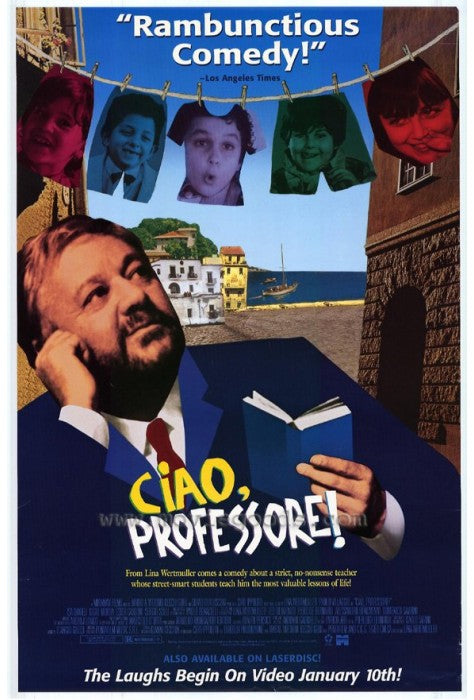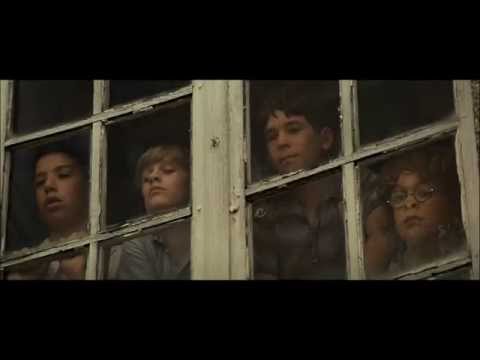
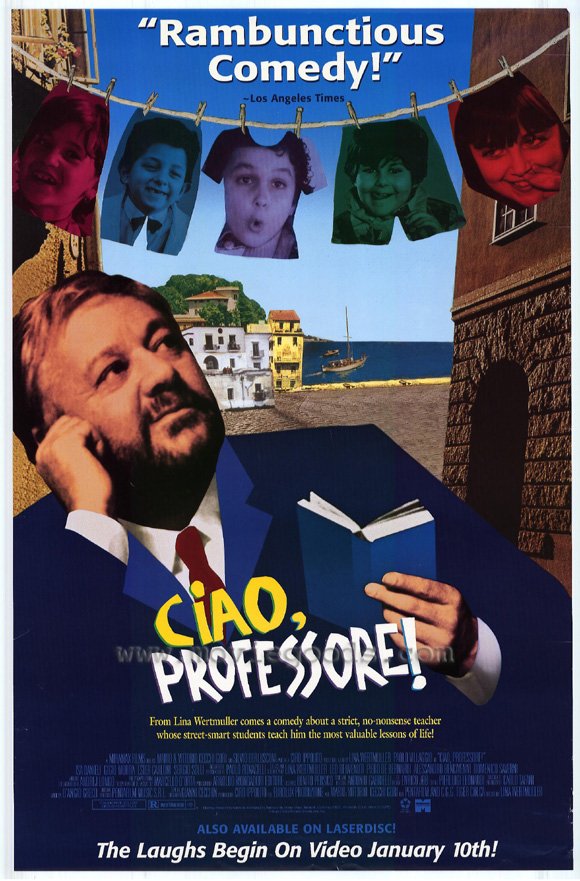
The Italian classroom you haven't experienced: a primary school classroom in a poor Naples neighborhood, where the assigned teacher is about to realize he's been sent to the wrong town (he wanted to be in the north) and the children he's been given are the ones nobody else wanted. Ciao, Professore! (I'm Starting from Three) is one of those rare Italian films that makes you laugh and feel deeply simultaneously, and it belongs in any Italian class that wants to give students access to Neapolitan Italy alongside standard Italian.
For Italian students, the film is linguistically rich in an unusual way: the Naples dialect is present throughout, and the gap between the teacher's standard Italian and the children's Neapolitan dialect is the film's central tension. Students hear how Italian varies by region — not as an abstraction, but as a daily friction between two people who technically speak the same language and still can't quite understand each other.
📬 Stay in the loop. New lessons added regularly — join the list to hear when your film is available.
Key Themes for the Classroom
- Class and education — The children come from families that the Italian system has already written off. The teacher's gradual refusal to accept that writing-off is the film's emotional engine. Ask: Perché il professore cambia idea sui bambini?
- Standard Italian vs. dialect — The film is explicit about the political dimension of dialect: the children's Neapolitan is a mark of social origin, and learning standard Italian is both opportunity and cultural loss. Ask: Cosa perde Marco quando impara l'italiano standard?
- Unexpected belonging — The teacher didn't want to be there. Then he doesn't want to leave. Ask: Cosa cambia per il professore durante il film?
Scene to use: The classroom scene where the teacher tries to take attendance and realizes almost nobody uses their legal name. The Italian of nicknames, family names, and the creative refusal to be the person your documents say you are is funny, human, and linguistically instructive. Ask: Perché i bambini non usano i loro nomi ufficiali? What is a name for, in this context?
Low-prep classroom activity: Students write a brief teacher's report in Italian — in the professor's voice, after his first week. He must describe three students, giving each one an accurate assessment of what they know and what they need. He must use at least one formal Italian educational term and one moment where his own assumptions are questioned. The task requires both Italian register and honest self-reflection.
What to listen for: The Neapolitan of Ettore Scola's Naples is one of Italian cinema's most distinctive dialects, and the film uses it with complete affection. The children speak a mix of dialect and standard Italian that reveals their social position: they know enough standard Italian to communicate with the northern teacher, but their default is dialect, which is home. Ask students: Quando i bambini parlano in dialetto, e quando in italiano standard? The code-switching reveals social awareness — these children know exactly when the dialect is appropriate and when it isn't, and that knowledge is itself a form of sophistication.
The full Italian lesson plan for Ciao, Professore! is ready at filmarobics.com/products/ciao-professore — $29.95.
Students walk away from Ciao, Professore! having heard Italian in one of its most regional, most alive forms — and having learned something important about who gets to define what "correct" Italian sounds like.
The full Italian lesson plan for Ciao, Professore! is ready at filmarobics.com/products/ciao-professore — $29.95.
📬 Stay in the loop. New lessons added regularly — join the list to hear when your film is available.
Students walk away from Ciao, Professore! having heard Italian in one of its most regional, most alive forms — and having learned something important about who gets to define what "correct" Italian sounds like.